Key Takeaways
- Wood-frame construction leaves homes vulnerable to a variety of risks
- Innovations in concrete alternatives help lower the total cost of ownership
- Property insurance carriers are more likely to underwrite a resilient home because of their lower risk factors
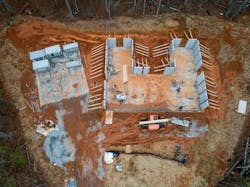
The old ways of building a home in California have reached a tipping point. The devastating wildfires that raged across Los Angeles in January, reducing entire neighborhoods to ashes, underscore the critical need to reconsider how homes in fire-prone areas are constructed.
Unfortunately, those fires were not isolated incidents. In 2024 alone, California experienced 8,024 wildfires, scorching over 1 million acres, destroying 1,716 structures, and displacing thousands of residents.
The state is among several, including Oregon, Washington, and Colorado, that are enduring an ongoing wildfire crisis that demands immediate and sustained action to protect residents, natural resources, and the economy.
Engineers have long advocated for the use of fire-resistant structural materials in residential construction, and both testing and real-world examples of those materials and design solutions have proven out. But higher costs compared to wood framing continue to hinder widespread adoption of more resilient structural systems, such as concrete.
As of 2024, only 5% of new homes nationwide used concrete as the primary structural system, the latest data point in a steady decline from a peak of 10% market share in 2019, according to the U.S. Census. (Even so, that percentage is skewed heavily by the South region, where 9% of homes are built with concrete; in every other region, the share of concrete homes is 1% or lower.)
But now, innovations are dramatically lowering the cost of using concrete for a home’s structure, and by adding fireproof doors, windows, and metal roofs to the spec list, homes can be transformed to be nearly fireproof.
Beyond Fire Resilience
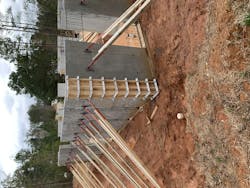
These advancements in residential concrete construction extend beyond fire defense, offering enhanced protection against other natural disasters such as hurricanes, tornadoes, and earthquakes.
“Concrete is by its nature a very durable and resilient material regardless of the hazard,” says Evan Reis, executive director of the U.S. Resiliency Council. “From the performance side of things, concrete homes make a ton of sense.”
Reis, a structural engineer with more than 30 years of experience, leads the California-based non-profit organization that advocates for well-engineered structures built with resilient materials.
“With more people moving to hazard-prone areas and the increase in natural disaster-related losses, something has got to change,” he says.
The Insurance & Lending Factor
Making matters worse is the harsh reality that many homeowners are now unable to secure home insurance.
According to the First Street Foundation, which offers financial modeling for climate risk, almost one-third of homeowners in the lower 48 states are already struggling to find affordable insurance, with California facing some of the most pressing challenges.
In fact, in the months leading up to the historic Eaton and Palisades wildfires in Los Angeles, many home insurance carriers began canceling policies across the state, leaving homeowners with few options.
“Insurance rates are skyrocketing because of the increased risk (and) lenders don’t want to be left holding the bag,” says Reis. “The good news is that they are both beginning to recognize that they can greatly reduce their risks if homes are built with the right materials.”
As governments and the insurance industry struggle to find viable solutions in the near term, discussions are increasingly turning to just what building material is going to replace the traditional wood-framed home design.
(Insurers and lenders are) beginning to recognize that they can greatly reduce their risks if homes are built with the right materials.

Building a Foundation
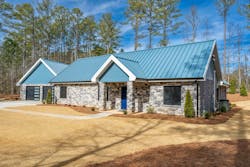
Building homes out of concrete has long been viewed as a superior option, especially in fire-prone areas like Los Angeles County. This approach would no doubt save lives, protect properties, and greatly reduce future government relief and recovery funds, but the higher cost of construction compared to wood-framed homes has been a major barrier.
But when lifetime upkeep, insurance, and other expenses are factored in, concrete homes are expected to greatly reduce the total cost of ownership.
The latest advancements piggyback on the tilt-up designs common in commercial construction. For residential construction, the cost savings come from utilizing smaller prestressed sandwich panels (which integrate insulation) which don’t require the use of expensive cranes. Instead, the panels can be maneuvered by forklifts, which also cuts down on labor needs and costs.
“An entire house can now go up with just 3 or 4 people onsite to tilt up the panels and set them in place,” says Alonso Forcado, an engineer from Nonquit Homes, based in Palacios, Texas, who helped design and build the first residential home outside of Atlanta using this style of construction.
The panels also can be poured on site, which eliminates the need to transport them from a precast manufacturer, increasing the cost.
The time associated with building concrete homes can also be greatly reduced when compared to traditional wood-framed designs.
For example, the average single-family home takes almost 8 months to go from start to completion (plus another month or so from permit to start), according to Census data, while large custom homes can take more than a year to finish.
But once a builder properly trains an in-house or specialty framing crew on a panelized concrete building process, or finds a concrete trade partner with those skills, building times can also be greatly reduced to as few as 120 days, depending on the size of the residence.
Resilience Requires Retraining
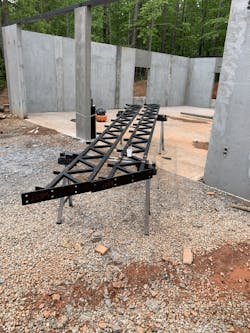
One of the biggest obstacles to seeing a transition from wood to concrete in residential construction comes down to the know-how. According to Reis, another big reason contractors, continue to build wood-framed homes is due to their familiarity with the process.
“Right now, there are simply not enough contractors that know how to efficiently build a home out of concrete,” says Reis, especially in areas outside the Southeast.
Getting contractors on board with the shift to concrete requires a proven process and training to build cost-effective, resilient, and well-designed concrete homes.
To further speed development into residential concrete construction, builders such as Nonquit Homes have begun offering educational courses for contractors.
The builder's 8-day program includes hands-on training that provides builders and skilled workers with the knowledge and ability to pour and erect prestressed concrete panels for quick and cost-effective residential construction.
“It took us almost two years to perfect the process of building with these prestressed concrete sandwich panels,” says Forcado. “Now we want to pass along what we have learned to builders before it’s too late. Right now, it is a race against time.”
Enhancing Durability
Another issue with constructing homes out of concrete includes insulation limitations and aesthetic concerns. Concrete is naturally dense and airtight, but it is not an effective insulator on its own.
To alleviate the issue, Nonquit Homes began integrating thick insulation within the concrete panels (hence the “sandwich” panel moniker). This approach not only improves energy efficiency, but also streamlines construction by eliminating the need for separate insulation on either side of the walls, which also reduces labor and materials costs and cycle time
In terms of design, the concrete industry has evolved significantly, offering a wide array of customization options, including colored, patterned, and textured finishes. Furthermore, builders can incorporate conventional exterior cladding materials such as brick, stone, or stucco to enhance curb appeal.
The Bottom Line
Concrete homes are proving to be a more resilient and cost-competitive option with lower energy consumption and fewer repairs—adding up to a more sustainable solution for housing.
“Sustainable design has always been translated into green design, or having a low impact on the environment, but that’s only half of the equation,” says Reis. “The other part is the environment having a low impact on us. By combining green design with resilient design, together we can achieve sustainability.”
About the Author
 Greg Rankin
Greg Rankin
Greg Rankin is a Houston-based freelance writer with more than 20 years of experience writing about construction, engineering, and the concrete industry.