This article initially appeared in the January/February 2026 issue of Pro Builder
Home builders across the country are struggling with rising land costs and market instabilities that erode profits and worsen housing affordability.
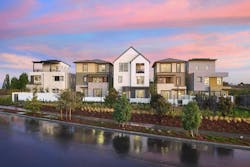
A strategy I’ve seen become popular in some of the country’s tightest housing markets is to build detached homes at higher densities on smaller lots.
The idea is to maximize yield on land traditional zoned for single-family and achieve densities comparable to townhome developments on sites where the cost of attached housing would squeeze margins, yet preserving the appeal of a standalone house.
With the right design strategies, these homes can reach densities of 14–to-18 dwelling units per acre, but hitting those numbers with homes that are attractive to buyers requires thoughtful planning around fire access, outdoor space, privacy, and massing.
Fire Access: The Hidden Driver of Massing
To reach three stories and maximize floor area, builders often find themselves balancing two seemingly conflicting priorities: requirements by fire officials for ladder access, egress windows, staging areas, and turning radiuses; and the desire of the local planning department for varied roof forms, articulated massing, and pedestrian-focused street patterns over wide, auto-oriented grids.
This tension between those two objectives directly affects the features that make homes livable and marketable. Ceiling heights, room sizes, outdoor space, and roof decks can all be constrained when fire departments require wider access lanes or clearances around the building perimeter.
The most effective strategy is to bring fire officials and planning department staff into the design conversation early and collaboratively so both parties understand the tradeoffs involved in achieving desired density, livability, and life safety.
One practical tool is to use enhanced in-home sprinkler systems, such as the 13D/13R configurations per the National Fire Protection Association (NFPA) that allow simpler designs, fewer sprinklers per calculation area, and less-demanding water supply—all of which can provide the flexibility needed to maintain massing and heights without compromising safety.
Engaging fire officials early often turns them from gatekeepers to collaborators, helping unlock solutions rather than limit them.
Rethink the Yard
Designers and builders assume that a backyard is a must-have feature in detached housing, but a 2025 survey by The New Home Trends Institute reports more than 60% of potential buyers are willing to compromise on lot size, meaning that a less-conventional outdoor space will still meet their needs.
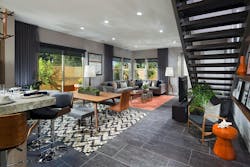
In fact, on small lots, backyards are frequently too shallow to function effectively or aesthetically, so a more effective approach is to trade a shallow rear yard for a deeper side yard. Many builders use an easement on one side of a house to create a shared offset, creating an eased side yard width of eight feet.
This solution provides a usable outdoor space that benefits from better light, privacy and a meaningful extension of interior space.
Livability on small lots is driven by orientation, not square footage, and an eased side yard can become the primary outdoor space and orientation point for the floorplan. By placing major windows and living areas along the yard, designers can bring in daylight and create visual and functional continuity between indoor and outdoor space.
Meanwhile, using minimal or high-sill windows on the other side of the house (facing a neighbor’s side yard) maintains privacy and limits sightlines between neighbors. The result also yields floor plans that intentionally incorporate outdoor space, making an outdoor area that feels private and usable instead of compromised.
Townhome Density Without Uniformity
At 14–to-18 units per acre, the challenge isn’t just density, it’s avoiding repetitive and blocky facades.
With townhomes, shared walls force plans to have the same depth, stair placement, and load-bearing alignment, which limits floor plans to front and back layout swaps.
Detached small-lot homes, however, allow greater variation in stair positions, room layouts, and window placements without affecting a neighbor’s structure.
Because windows aren’t limited to just the front and rear elevations on detached plans, bedrooms and living spaces can be placed on the side of the home, opening up more space-use options and allowing for more varied massing.
A two- to three-foot shift in plan depth or stair alignment may be enough to break the appearance of repetition without suffering more expensive framing.
Rooflines and elevations can also vary cost-effectively in detached conditions. Minor ridge height changes, front-to-back roof orientation or porch depth adjustments can differentiate homes in a way that satisfies design review and neighborhood expectations without added cost.
The ADU Option
At the densities proposed, every square foot counts, especially on the ground floor. And on a small lot, there is scant space to accommodate an accessory dwelling unit (ADU). Even so, an ADU can still be the best way to address affordability for both owners offsetting a mortgage payment, renters looking for efficient, attainable housing, or an aging parent moving down.
The most viable approach is to integrate an ADU within the primary structure’s footprint, such as converting a ground floor bedroom and bath into a lock-off suite with a separate entry and kitchenette.
Such “integrated” or “in-plan” ADUs maintain clean site circulation and fire-access compliance, and they appeal to investors without altering exterior massing.
A New Playbook for High-Density SFD
Delivering detached homes at 14–to-18 units per acre isn’t about squeezing more product onto a site. It’s about using fire access, yard orientation, massing, and ground-floor flexibility as strategic tools to make density constructable and enjoyable.
When these pieces work in concert, builders can produce homes that satisfy planning departments, meet buyer expectations, and pencil-out profitably in markets that won’t support attached housing.
The result is not just higher yield, but a housing type that expands what’s possible on small infill and suburban sites.
About the Author
 Jonathan Boriack, AIA
Jonathan Boriack, AIA
As principal of KTGY’s single-family residential studio in Oakland, Calif., Jonathan Boriack, AIA, LEED-AP, NCARB, focuses on the master planning, design, and construction of new single and multifamily communities for public and private home builders throughout Northern California.