Liquid Applied Technologies Simplify Building Envelope Installation
Key Highlights
- Learn how liquid-applied technologies integrate WRB and flashing to create continuous protection.
- Understand how dual-purpose products can simplify installation, reduce material changes, and save labor.
- Learn which testing, compatibility, and application requirements matter when selecting a system.
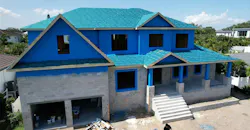
Liquid-applied technologies are providing builders with options to seamlessly integrate their water-resistive barrier (WRB) with the flashing around openings. By forming a bonded membrane directly on the substrate, these liquid-applied products can follow complex shapes and reduce the number of products and detailing steps needed to protect the building envelope.
This versatility matters wherever wall protection must connect across different surfaces or changes in geometry. Keeping those connections continuous is essential to managing water behind the cladding, and this installation method helps crews complete those details consistently.
Versatility at Critical Details
A WRB helps prevent bulk water intrusion behind exterior cladding. Flashing protects vulnerable connections at windows, doors, and penetrations. Both depend on continuity and proper integration to direct incidental moisture toward the exterior.
Liquid-applied flashing dries or cures into a flexible membrane that conforms to rough openings and irregular transitions. This can simplify corners that otherwise require cutting, folding, and fitting sheet materials. These details are especially important where wind-driven rain can force water past exterior joints.
This approach is gaining recognition in codes and installation guidance. Liquid-applied flashing is recognized in Florida’s building code and recommended in installation guidance for masonry and concrete window openings. Florida’s residential code requires liquid-applied membranes used as exterior-wall flashing to comply with AAMA 714. Self-adhering flashing falls under a different standard, AAMA 711.
The new 2026 AAMA/WDMA 100 standard includes liquid-applied flashing methods for windows with mounting flanges in membrane drainage wall systems. The updated standard expands its scope beyond extreme wind and water exposure to general new construction applications, reflecting broader recognition of these installation methods.
Liquid-applied WRBs extend membrane coverage from rough openings to the broad wall surfaces of the building. Some new formulations can function as both WRB and flashing, allowing the same material to connect field coverage with opening details. It is critical to verify approved applications and compatibility with surrounding materials.
A rough opening may involve several substrates and changes in geometry. It should be confirmed that the membrane adheres to each surface and that adjoining sealants or coatings are compatible. Joint widths and anticipated movement also matter. Follow the system’s details for sealant, reinforcement, and transitions rather than assuming the field coating can bridge every gap.
Simpler Installation
Depending on the technology and application, crews can spray, brush, roll, or trowel-apply product to the substrate. Where a coating serves as both WRB and flashing, its dual-purpose function can reduce product changes and labor spent handling separate flashing materials.
“Contractors are looking for systems that are easier to install consistently,” says Rob Stannard, Vice President of Chemical Technology at Tower Sealants. “Liquid-applied systems can simplify difficult transitions and reduce separate detailing steps. That practicality is an important reason for their adoption.”
Planning begins before coating. Check substrate condition, joint preparation, and the weather forecast. Application temperature, surface moisture, and drying or curing requirements vary by formulation. Schedule enough time before rain exposure and subsequent construction, and coordinate with the crews installing windows and cladding.
Cost comparisons should include the complete installation. Count flashing, accessories, and preparation alongside the field WRB, then account for application labor, equipment, and cleanup. Fewer separate materials can simplify purchasing and staging. Actual savings depend on wall complexity, the number of openings, and crew productivity.
Performance Remains Key
Versatility must be supported by proper installation and testing. Prepare all substrates, treat joints, and check specified thickness with a wet-film gauge. A coating that looks continuous may still be too thin, particularly over textured or porous surfaces. Inspect for pinholes and follow temperature and drying requirements.
For wraps, tapes, and liquid membranes, review documentation appropriate to the intended use. Consider water resistance, adhesion, vapor transmission, and fastener sealing. Compare tested substrates and application thicknesses with the proposed installation so the published results are relevant to the work.
Water resistance and vapor permeability describe different properties. A membrane can resist liquid water while allowing water vapor to diffuse through it. That drying potential should suit the climate and the complete wall assembly. An air barrier also needs continuous connections at openings and adjoining assemblies to control leakage.
Relevant references include AAMA 711 for self-adhering flashing and AAMA 714 for liquid flashing. ASTM E96 addresses water vapor transmission through a material, helping assess its contribution to drying potential. ASTM E2178 measures material air permeance, while ASTM E2357 evaluates assembly air leakage. Match the testing to the product’s intended role and the project requirements.
Combining WRB and Flashing
Tower Sealants’ AU-1 LAB is a single-component, water-based product designed and tested for both full-wall WRB coverage and liquid flashing. Using the same membrane across wall surfaces and rough openings simplifies material selection and installation while reducing transitions between separate products.
It can be sprayed, rolled, or brushed on, giving contractors flexibility to match the application method to the wall surface or opening detail. The product adheres to common substrates, including OSB, plywood, exterior gypsum, concrete, and masonry. Uncured material and tools clean up with soap and water.
Its vapor-permeable membrane self-seals around cladding or window-flange fasteners when properly applied. Tower’s AU-1 LAB was tested in accordance with ABAA performance requirements for WRB materials and meets the performance requirements of AAMA 714-22 for liquid flashing.
Installation guidance calls for a minimum of 30 wet mils, with thickness checks and inspection for pinholes. Following the specified preparation and application details helps crews connect field coverage and flashing within one system. For approved applications and project-specific guidance, visit towersealants.com.