Rethinking Post-Fire Rebuilding Strategies
Story at a Glance:
- The Anoka House uses layered fire-resistant materials, including brick exteriors and fireproof sheathing, to improve resilience against wildfires.
- Resilience in architecture can be achieved without complexity by focusing on clear, deliberate choices that prioritize occupant safety.
- Design simplicity and standard wood framing make Anoka House scalable, cost-effective, and easier to replicate across rebuilding projects.
- Eliminating vulnerable features like eaves and attic spaces reduces entry points for embers, enhancing fire safety.
This article initially appeared in the March/April 2026 issue of Pro Builder
It’s been over a year since wildfires devastated communities in Los Angeles, and efforts to rebuild are ongoing. One architect working to rebuild in the city’s Pacific Palisades neighborhood is Zoltan Pali, founder and design principal of Los Angeles-based architecture firm SPF:a.
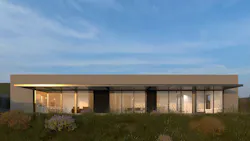
Pali’s Anoka House is a 2,510-square-foot fire-resistant prototype that he hopes will help promote responsible and resilient home design throughout the area. As he currently works with a homeowner to make the concept home a reality in the Palisades, one thing is certain: His goal is not to simply rebuild but to create a smarter solution that will keep occupants safe for years to come.

PRO BUILDER: What’s the origin story of this project?
Zoltan Pali: The project came about after the fires destroyed a house in the Pacific Palisades. The homeowner reached out to us not long after the fire because he intended to rebuild the home.
PB: What did you want to accomplish?
ZP: From the beginning, we were very transparent that the new house would not replicate the original. It would reflect our design approach and respond to the realities of rebuilding after a wildfire.
Two things guided the design process from the start: cost and resilience. Insurance typically doesn’t cover the full cost of rebuilding, so the house had to be carefully designed to stay within budget.
We also wanted to build something that would have a much better chance of surviving a future fire event. The site itself didn’t change much. The driveway stayed in the same place, and the general layout of rooms is similar to the original home.
PB: What’s the firm’s background with resilient design?
ZP: Resilience is something that’s always been part of our work, especially in Southern California. Most of the homes we design are custom projects, and clients often come to us already thinking about issues like earthquakes, fire, water intrusion, or thermal performance.
Personally, I entered the profession shortly after the Northridge earthquake [in 1994], which had a huge impact on building codes in Los Angeles. Structural systems became much more robust after that, and that mindset has always been part of how we approach design.
PB: What’s your approach to making this home fire resistant?
ZP: Resilience really comes from the envelope. The exterior walls are layered with multiple protective materials. Inside you have standard 5/8-inch drywall. On the exterior side of the structural sheathing we add another fire-resistant sheathing layer, and then the entire building is wrapped in brick.
Walking through the fire zone, one of the things that struck me was that the only elements still standing were the chimneys. That observation inspired the decision to use brick as the exterior skin of the house.
The roof is also designed to resist ember ignition. It uses a fire-resistant sheathing system with a single-ply PVC roof. In this assembly, embers can burn through the outer membrane but will extinguish when they hit the fire-resistant layer beneath it.
We also eliminated many of the areas where fire can enter a house. There are no eaves, no attic spaces, and the home sits on a slab foundation so there’s no place for fire to get underneath it.
PB: What has been your biggest takeaway from working on this project?
ZP: The biggest lesson is that resilience doesn’t have to mean complexity. This house is essentially a very simple box, and every decision was intentional. When you design clearly and deliberately, it’s much easier to control cost and performance.
Cost will probably be the biggest challenge for most homeowners rebuilding after a disaster, so builders and architects have to be extremely mindful of where money is spent and where it can be saved.
And in rebuild situations, there can be regulatory constraints. For example, local ordinances often limit the size or height of replacement homes, which affects how much flexibility you have in the design.
In the case of this project, specifically, the local rebuilding ordinances mandated that rebuilt or replacement homes cannot increase in size by more than 10%, so this new house is only slightly larger than the original footprint.
PB: You designed this home to be scalable. What are the repeatable elements of this home?
ZP: Repeatability was an important part of the concept. By designing a straightforward structural system and minimizing custom construction details, the house becomes much easier to replicate.
We avoided complicated structural spans, heavy steel framing, or unusual systems that require highly specialized labor. Instead, we relied on standard wood framing and a clear structural grid. That means most framing crews can build it without having unique expertise.
The idea is that this type of approach could be applied across many rebuild projects. When you keep the structural system simple and focus resilience for the building envelope, the design becomes more scalable and cost-effective.
PB: How do you talk to clients about making responsible design choices?
ZP: Our role is to guide a client’s concerns into practical design decisions, including stronger structural systems, better waterproofing, fire-resistant materials, and thoughtful detailing.
At the end of the day, it comes down to being intentional. Every component of the building should contribute to performance, resilience, and longevity. When clients understand that approach, they’re usually very supportive of those decisions.
PB: If you had to choose one thing to make a home more fire-resilient, what would it be?
ZP: Layer the exterior wall system with fire-resistant materials. One of the biggest lessons from the fires was that many houses lost their structural framing even though the exterior stucco remained standing. The fire got inside the walls through openings or vents, and once it reached the wood framing the house burned from the inside out.
Adding layers of fire-resistant sheathing and exterior materials dramatically improves performance. At the same time, eliminating vulnerable elements—like large eaves, attic spaces, or crawlspaces—removes places where embers can enter the building. Those changes alone can make a significant difference.