New Approaches to Disaster Relief and Resiliency
This article initially appeared in the March/April 2026 issue of Pro Builder
As climate change drives up the frequency and intensity of natural disasters, the need for sustainable and resilient housing solutions is ever present, not just for those displaced during rebuilding, but also long term.
“People are starting to realize that if you’re going back to a place that’s been impacted by these outcomes and you’re planning on just doing what was done there before, you’re going to end up in the same place,” says Tom Hoban, president and CIO at Kitson & Partners, the real estate developer behind Babcock Ranch, a resilient master-planned community in southwest Florida.
“Given all that’s happened in the last decade, and the billions of dollars in damages, people are starting to recognize we’ve got to do this better.”
Quality Homes Quickly Deployed
Liv-Connected, established in 2019, was born out of DXA Studio, an architectural firm based in New York City and founded by Jordan Rogove and Wayne Norbeck in 2011. Initially, Liv-Connected aimed to address the housing supply gap through the design and off-site construction of affordable (what Rogove calls “achievable”), high-quality modular homes.
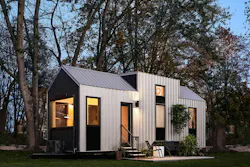
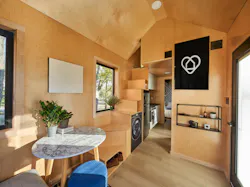
Through that work, the team quickly concluded that its approach also was well-suited for disaster-relief housing and has since introduced two models: The Conexus, a customizable design featuring one to five bedrooms; and the Vía, a tiny home measuring from 200 to 400 square feet and featuring removable wheels—ideal for first responders faced with weeks or months of on-site work.
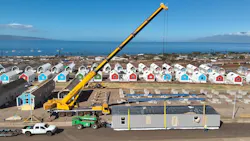
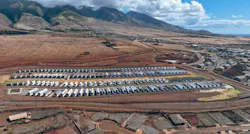
In late 2024, the Federal Emergency Management Agency (FEMA) commissioned Liv-Connected to provide 109 Conexus units to survivors of the wildfires that swept through Lahaina Town and surrounding communities on Maui, Hawaii, in 2023.
Liv-Connected delivered the homes over the course of four months, a level of response made possible through the company’s relationships with multiple modular home manufacturers in the western U.S.
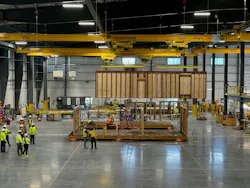
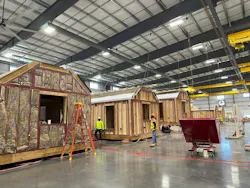
“For disaster relief, they need way more units than a single manufacturing facility can provide, and so those partnerships allowed us to expand our output by a factor of 12,” Rogove says.
A primary challenge faced by Liv-Connected and other disaster-relief housing providers is creating rapidly deployable housing that complies with local building codes. To minimize delays and red tape prior to deployment, Liv-Connected’s designs adhere to the latest (and most strict) versions of the International Residential Code (IRC).
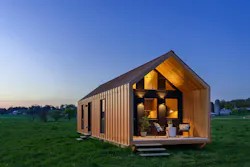
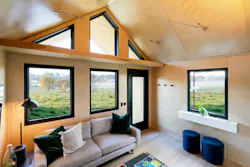
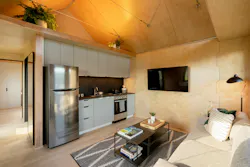
Currently, Liv-Connected is working with the state of Texas on a preemptive disaster-relief housing initiative, which envisions the construction and storage of a large inventory of homes before an event occurs to reduce deployment times to mere days.
“They told us that the scale of the disasters they expect can’t be managed by a bunch of contractors to rebuild houses,” Rogove says. “They expect to have entire communities, if not cities, that will need to be accommodated.”
Liv-Connected is also in discussions with building authorities in California about providing disaster-relief housing solutions to that state, as well, including the Pacific Palisades and Altadena communities ravaged by wildfires early last year.
Construction on Demand
Founded by Geoff Hackett and Spencer Padgett, Ghost Factory deploys mobile modular building manufacturing facilities wherever, whenever required.
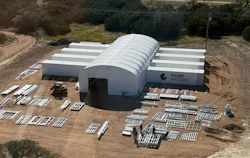
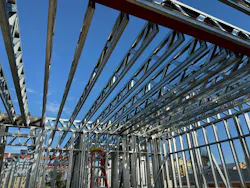
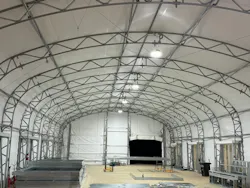
The method: Standard shipping containers are transformed into cold-formed steel manufacturing lines capable of fabricating walls and roof and floor trusses from recycled materials and fitted with mechanical, electrical, and plumbing runs for a fast build cycle.
The company has played a key role in the rebuilding efforts following the 2025 wildfires in Los Angeles County, and is also deploying its micro-factory solution in Lampasas, Texas, and southern Utah.
“We are erecting a kit of parts rather than cutting and installing every stick and brick, [which] relieves a lot of the pain and suffering and interference that comes with the construction process,” Hackett says, resulting in faster build times at lower costs.
“Hopefully it will advance the industry forward and be a new model in non-disaster markets as well so a lot more projects can become a reality, and we can get ahead of this housing shortage for once and for all.”
Working With the Environment
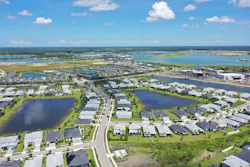
While climate change mandates the need for disaster relief housing, it’s paramount for developers, architects, and builders to create communities that better weather to extreme events in the first place. Babcock Ranch, a master-planned, mixed-use community spanning 18,000 developable acres that expects to serve 45,000 residents at build-out, took that mandate to an extreme.
“We’ve got a responsibility as a developer to create places that can give people peace of mind, that they’re living in a place where they’re not going to be at risk of loss, whether that be financial loss or loss of life,” Hoban says.
To that end, much of the firm’s early planning and design involved determining the best methods of drawing power, accessing and delivering water, and situating roads and buildings in places where the water flows naturally, as it has historically on the site.
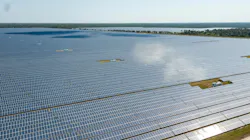
Meanwhile, the substations for a 150-megawatt solar farm are elevated to avoid flooding, all the power lines run underground, and the poles between the substations are concrete. “We’ve got very strong power redundancy,” he says.
Challenges Remain
Michelle Foster is VP of sustainability at Home Innovation Research Labs, a consulting, research, and testing firm based in Upper Marlboro, Md., focused on the residential built environment.
She notes that one of the primary bottlenecks in the deployment of disaster-relief housing is directly linked to funding. For example, for disasters where federal funding relief is available, it takes time to be released for rebuilding to commence at scale.
“We have this long waiting period, then the money gets allocated, and then everybody is trying to go as fast as possible because these families have lived for such a long time with either substandard housing or no housing,” she says.
Another issue is affordability. While people with the means to do so may not need or want to wait for federal funding to rebuild or relocate, that scenario is less likely for lower-income households displaced by a disaster. For these families, the goal is to provide housing options that are higher performing and more resilient than their previous homes, but also are affordable.
“And not just affordable to buy, but to live in as well, so they don’t have high ongoing operational, maintenance, or replacement costs,” Foster says.
As the industry continues to evolve its approach to disaster-relief housing, Foster argues that it’s important to avoid tunnel vision. For a long time, she says, the focus was on hurricanes, but as climate change intensifies, it’s necessary to build with wildfires, floods, earthquakes, and tornadoes in mind, too.
“That’s one of the challenges that we’re looking at going forward—how to be responsive to a multitude of challenges, because some homes may have to face a number of them, not just one.”
About the Author
 Carolyn Heinze
Carolyn Heinze
A full-time freelance writer, Carolyn Heinze contributes to a vast selection of trade journals and websites, covering everything from advertising and architecture to broadcasting, electricity and energy, entertainment, and housing, among several other interest areas.