Why Are You Still Stick-Framing Your Roofs?
This article also appeared in the July/August 2026 issue of Pro Builder.
Across the country, production home builders face increasing pressure to deliver homes that are cost-effective, durable, energy efficient, and safe, while also meeting aggressive construction schedules and evolving homeowner expectations.
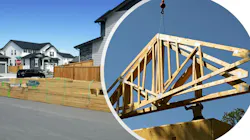
One of the most impactful innovations that helps builders meet these demands is the widespread use of engineered roof trusses in single-family residential construction.
From high-wind coastal regions in Florida to heavy snow-load markets in the Midwest and Northeast, engineered roof trusses provide a reliable framing solution that is adaptable to nearly every climate zone and architectural style.
Unlike conventional stick-framed roof assemblies built piece-by-piece in the field, engineered trusses are precision-manufactured in controlled factory environments using advanced software and structural engineering principles.
This level of precision significantly improves framing consistency and reduces the variability that is commonly associated with field-built roof systems.
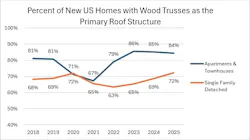
No wonder 72% of single-family homes and 84% of apartments and townhomes in 2025 were built using engineered roof trusses, according to the Annual Builder Practices Survey conducted by Home Innovation Readearch Labs (see chart, below).
The 5 Advantages of Engineered Roof Trusses
Engineered roof trusses offer several advantages that reduce time, costs, and material waste while helping enhance a home’s energy efficiency, deliver better construction quality, and improve jobsite safety.
Reduce Cycle Time. For production builders, one of the greatest advantages of engineered roof trusses is cycle-time reduction.
Where efficiency directly impacts profitability, reducing framing time by even one or two days per home can create substantial scheduling and labor benefits across an entire community.
Trusses arrive at the jobsite pre-built and ready for installation, allowing framing crews to dry-in homes faster.
Reduce the Cost of Construction. Cost is another factor that drives truss adoption.
Engineered trusses optimize lumber usage through calculated load paths and triangulated structural designs, often requiring less material than conventional framing methods.
This material optimization not only lowers costs, but also reduces jobsite waste—another cost on both the front end and to haul it away.
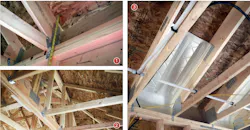
Enable Better Energy Efficiency. From a building performance perspective, trusses also create opportunities for improved energy efficiency and mechanical system integration and performance.
Raised-heel or energy trusses, for example, allow for full-depth attic insulation at exterior wall intersections, reducing thermal bridging and improving overall building envelope performance.
Open-web floor and attic truss configurations can also simplify HVAC routing, plumbing runs, and ventilation design. In turn, they can minimize unnecessary penetrations and help builders maintain tighter, more efficient building assemblies.
Create Better-Built Homes. Engineered trusses can also provide durability and structural reliability.
Because engineered trusses are designed for specific loading conditions including wind uplift, seismic activity, and snow accumulation, they provide dependable structural performance that is specific to regional construction requirements.
In attached-home construction, such as townhomes, truss systems can support complex roof designs while maintaining critical fire separation and meeting structural requirements.
Improve Jobsite Safety. Construction safety is another area where trusses provide measurable value. Factory fabrication reduces the amount of elevated cutting, measuring, and assembly required on-site, helping decrease worker exposure to fall hazards and other framing-related risks.
Additionally, faster dry-in times reduce weather exposure for both workers and building materials.
As builders continue to strive to construct homes that are resilient, efficient, and affordable, engineered roof trusses remain one of the most valuable tools supporting modern residential construction.
High-performing homes are never the result of just one decision… they are the result of the successful execution of hundreds of details done correctly, and engineered roof trusses can play a critical role in this mission.
About the Author
John Koenig
John Koenig drives quality and performance in home building as a building performance specialist on the PERFORM Builder Solutions team at IBACOS.