What Lies Beneath: The Hidden Elements of High-Performance Homes
Key Highlights
- Simplifying wall assemblies by integrating functions into fewer materials can decrease complexity, errors, waste, and overall embodied carbon.
- Durability and ease of construction are vital; a well-designed, long-lasting wall may have a lower environmental impact over its lifespan than a seemingly low-carbon but fragile assembly.
- Designing for performance, resource efficiency, and constructability ensures that walls meet sustainability goals in real-world conditions, not just in theoretical models.

This article also appeared in the September/October 2026 issue of Pro Builder.
Look at typical wall assemblies in high-performance homes today, and there’s a high probability you’ll find exterior insulation, cavity insulation, air barriers, moisture barriers, vapor retarders, flashing membranes, tapes, sealants, clips, and probably a few other elements—most of which are there to help control heat, air, and moisture. And those buildings are generally better because of it, when it’s assembled correctly.
But there is another question we need to start asking: What did it take to build that wall? The answer is embodied carbon.
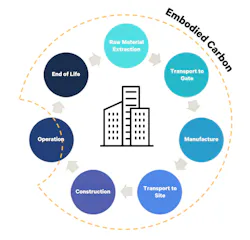
Embodied carbon includes carbon emissions from extracting raw materials, manufacturing, transportation, installation and ultimately, end of life.
By contrast, operational carbon refers to the emissions associated with the energy consumed throughout a building's life cycle that contribute to climate change.
As improvements in building design and energy efficiency reduce operational carbon and its emissions, the embodied carbon becomes an increasingly important consideration.
The Carbon You Don’t Always See
When talking about embodied carbon, there is a tendency to compare individual products against one another.
For example, insulation type A may have a global warming potential of one value, while insulation type B has another. The instinct may be to simply select the product with the lower embodied carbon number.
These comparisons are useful, but buildings are not constructed from individual products in isolation. Wall assemblies rely on multiple materials arranged in a specific sequence to satisfy building science principles and performance requirements.
Building Assemblies vs. Products
A wall assembly does not care about a material’s product Environmental Product Declaration (EPD), no matter how impressive, if six other materials around it are required to make the assembly perform as intended.
Insulation may require a separate air barrier, while that air barrier needs primers, tapes, transition membranes, and sealants. Exterior insulation may require longer fasteners, clips, strapping, or other attachment systems. Every material must be manufactured, transported, installed, and eventually dealt with as construction waste, thus contributing to the assembly's embodied carbon.
Nobody is suggesting that a roll of flashing tape is destroying the planet, but multiply those seemingly insignificant materials across 200 houses or an entire subdivision and the numbers become more interesting.
For production home builders, small improvements become significant when repeated hundreds of times. Eliminating a delivery, installation step, or some construction waste can add up quickly, especially if a simpler assembly also reduces errors and callbacks.
Performance Comes with Trade-Offs
Before everyone starts deleting layers from their wall details, complex assemblies did not appear because architects and building scientists were bored and needed something else to draw.
Most layers exist because we learned, sometimes the hard way, that buildings need reliable strategies for controlling heat, air, water, and water vapor. Removing materials simply because they have embodied carbon is not the answer; a wall that fails after 15 years is not particularly sustainable.
Instead of asking which insulation has the lowest embodied carbon, perhaps we should also ask what does the entire wall require to perform to our intent and expectations? In the right assembly, combining several control functions into one material may eliminate components, reduce interfaces, or simplify installation.
An example is closed-cell spray polyurethane foam insulation, which—depending on the product, thickness, climate, and assembly design—can provide thermal insulation while also contributing to air, moisture, and vapor control.
Those qualities do not automatically make spray foam the lowest-carbon solution, or another insulation inherently better or worse. Building science rarely gives us neat, convenient answers.
If Wall A uses insulation with a lower product-level carbon footprint but requires additional membranes, attachment systems, fasteners, and installation steps, while Wall B achieves the same performance with fewer components, comparing only the insulation may not tell us much. Rather, we need to compare systems against systems.
The goal should not be the fewest materials, but rather the right materials, doing the right jobs, in the simplest durable assembly that can reasonably be built.
The Jobsite Matters, Too
Another part of embodied carbon can get lost when we spend too much time looking at spreadsheets. A theoretically perfect wall is not very useful if it requires twelve trades, seventeen transition details, perfect weather, and perhaps a full moon to install correctly.
Construction is messy. Materials get damaged, fasteners miss studs, and penetrations appear after the air barrier contractor leaves the site. More components mean more interfaces and more opportunities for errors, labor, sequencing challenges, deliveries, and waste.
Sustainability cannot exist only inside an EPD or energy model because eventually somebody wearing work boots has to build what’s been drawn.
The Bigger Picture
Durability may ultimately be one of the most important pieces of the embodied-carbon discussion. Replacing wet insulation, rotten sheathing, failed membranes, or damaged finishes carries another environmental and financial cost.
A durable assembly that manages heat, air, and moisture for decades may therefore be a better environmental decision than one that looks impressive in a product comparison but proves difficult to construct or maintain.
That brings us back to one of the simplest lessons in building science: Design building assemblies, not materials. The goal should not be the fewest materials, but rather the right materials, doing the right jobs, in the simplest durable assembly that can reasonably be built.
Ultimately, the most sustainable wall is not necessarily the one with the lowest carbon number on a product data sheet. It is the one that delivers the required performance, uses resources intelligently, can actually be built correctly, and is still doing its job decades from now.
About the Author
 Rockford Boyer
Rockford Boyer
Rockford Boyer, B. Arch. Sc., MBSc, BSS, is a building science leader at Elastochem Specialty Chemicals. He brings over 20 years of technical knowledge in sustainable building design and works closely with architects using energy modeling technology to implement sustainable design strategies.