7 Reasons Why Energy Star Still Matters
Key Takeaways
- In 2023, 12% of all new homes were built and certified to Energy Star standards
- Trade partners must understand and follow the Energy Star checklists that apply to their work
- During construction, a qualified verifier will ensure the home on track to earn certification
This article initially appeared in the January/February 2026 issue of Pro Builder
It seems like every few months we hear of another federal or state program that supports better-built housing being either scaled back or phased out. Incentives are shrinking, funding is scarce, and builders are being asked to do more with less.
But there’s one program that’s quietly held its ground for more than two decades: Energy Star, a voluntary program established in 1992 and administered by the U.S. Environmental Protection Agency (EPA) in partnership with the U.S. Department of Energy (DOE).
While similar initiatives have come and gone, Energy Star remains the industry’s benchmark for homes that use less energy, perform better, and keep homeowners more comfortable.
More than 2.7 million homes nationwide have earned Energy Star certification since the program's inception and in 2023 represented 12% of all new homes built.
Achieving Energy Star certification isn’t just a marketing badge; it’s a rigorous, science-based process grounded in systems thinking and verified by third-party experts.
If you’ve ever wondered what it takes to get a home Energy Star certified (or why it’s still worth the effort), consider the process and what it means for builders, trades, and ultimately, your homeowners.
1. Partnering with Energy Star
The journey begins when a builder becomes an Energy Star partner through the EPA, committing to meet the program’s detailed requirements.
Namely, builders must work with certified third-party verifiers who inspect and test each home to confirm it meets the Energy Star performance standard, and specify Energy Star-certified products, which currently number more than 80,000 across 65 categories.
Your trade partners play a vital role, as well. From framing to HVAC to insulation, every player on the jobsite must understand and follow the Energy Star checklists that apply to their work.
Collaboration and communication with and among your trades are key from day one.
2. Plan Right: Design and Specification
Before construction begins, the builder, key trades, and the verifier (typically a rater for the Home Energy Rating System, or HERS) review the home’s design to ensure that it aligns with Energy Star’s requirements.
That process confirms proper insulation levels that meet or exceed standards in the International Energy Conservation Code (IECC), such as R-20 for 2x6 walls; achieving overall air tightness of 3 air changes per hour at 50 pascals (ACH-50) or better depending on climate zone; and designing HVAC systems correctly using Manual J (load calculations), Manual S (equipment sizing), and Manual D (duct design) from the Air Conditioning Contractors of America (ACCA) for guidance.
The HVAC design report, mechanical ventilation strategy, and home energy model all come together at this stage to create a blueprint for a high-performance homes, and getting these details right early prevents costly redesigns and rework later.
3. Build Smart: Pre-Drywall Verification
During the home’s construction, and in addition to your local building inspector, the verifier will perform a series of inspections and diagnostic tests to ensure the home is meeting the design specifications and performance targets to earn certification.
Every home must be inspected and tested, and initially, the verifier will perform a pre-drywall inspection to confirm the following items:
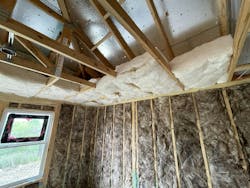
- An air sealing and insulation inspection per the Energy Star verifier field checklist;
- Verification of blocking and baffles to support Grade I insulation;
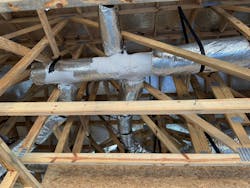
- Duct insulation quality and rough-in testing (if applicable) to meet a target air flow of at or less than 4 cubic feet per minute (CFM) per 100 square feet of conditioned floor area (CFA)
The appropriate trades must seal all penetrations in the home’s thermal shell and ensure ducts are properly sealed and supported. This step ensures the home’s “bones” are tight before anything gets covered up.
On January 8, 2026, the U.S. House of Representatives passed a spending package that fully funds the Energy Star program for the current fiscal year. See more below.
4. Finish Strong: Final Testing and Commissioning
When the home is completed, it goes through final testing, typically a blower door, duct leakage, ventilation flow, and verification of HVAC commissioning. The verifier ensures that all relevant systems work together as designed and meet Energy Star’s performance thresholds.
They’re not just testing numbers; they’re verifying that the systems work together as designed. Balanced ventilation, efficient ducts, proper airflow—this is where the home proves itself.
The home also must include Energy Star–certified lighting fixtures, ventilation fans, and appliances—of which there are almost unlimited options—to gain whole-home certification.
5. Certification and Documentation
Once the home passes all inspections and tests, the verifier submits the results to a rating provider working under a Home Certification Organization (HCO) for final review.
The builder receives an official Energy Star Certificate, HERS rating (or score), and that recognizable blue Energy Star label to use in marketing and sales.
Builders also should retain all supporting documentation for potential EPA/HCO audits.
6. Tips from the Field
Earning Energy Star certification for your homes is a total team effort that required collaboration and constant communication, as well as a shared mission to build better.
Builders that have gone through the process and honed it with willing and skilled trade partners and product suppliers generally follow these steps:
- Start with a team huddle. Bring your Energy Star verifier and trades together before the job starts;
- Train with checklists and mockups. It’s the easiest way to build consistency;
- Get to know your verifier! They are your best friends to keep you on track;
- Air-seal as you go. Waiting until the end never works; and
- Verify HVAC designs early. Avoid oversizing and suboptimal duct layouts.
7. Why It Still Matters
Energy Star certification isn’t just a label. It’s proof that the home meets one of the industry’s most trusted standards for comfort, quality, and energy efficiency.
Even as energy-saving incentives fade, builders who commit to Energy Star are proving—with data and third-party verification—that their homes aren’t just built, but built better.
As the industry faces new and ongoing challenges, that distinctive and recognizable blue label might just mean more now than ever.
Congressional Support for Energy Star
On January 8, 2026, the U.S. House of Representatives passed a spending package that fully funds the Energy Star program for the current fiscal year. The bill is expected to pass the Senate and be signed into law before the January 30 funding deadline.
The bill includes approximately $33 million for the Energy Star program within the Environmental Protection Agency (EPA) budget, maintaining its current funding level.
The spanding package was a bipartisan effort to save the program from previous administration proposals to eliminate or privatize its funding. The overall spending package passed the House with an overwhelming 397-28 vote.
About the Author
 Ari Rapport
Ari Rapport
Building Performance Coach
Ari Rapport drives quality and innovation in homebuilding as a building performance coach at IBACOS. He has over 20 years of experience applying building science principles to improve the housing quality and performance and previously managed IBACOS’ building performance research and development programs with the U.S. Department of Energy.