Q+A: Michael Padavic on Upzoning Infill Lots to Enable Affordable Housing
Listen to the full interview with Michael Padavic here.
Michael Padavic is the senior principal at Dahlin Group’s Austin, Texas office, which provides architectural and planning services for builders and developers, from single family to multifamily projects.
Earlier this year, Michael approached us with an intriguing premise: That while they say everything is big in Texas, it seems that lot sizes on urban infill sites are shrinking to accommodate higher densities and more attainable housing, including single family. And not only in Austin, but now statewide based on legislation signed into law that will affect the majority of Texas metros and citizens.
In this interview, Michael provides real-world insights on the challenges and opportunities afforded by high-density single family, who is developing these urban infill lots, and the role of planning and design to ward off pushback from nimbyism and attract buyers otherwise locked out of that housing segment.
Pro Builder: What’s driving the push to reduce lot sizes and make it easier for denser development on urban infill lots in Texas?
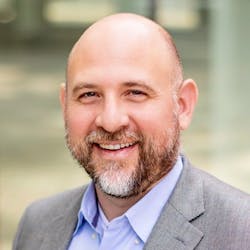
Micheal Padavic: I think the key word driving everything is affordability. We've had some success in Austin over the last 10-plus years rezoning properties to a little higher density but still keeping a single family nature in place. It just showed that if you can get one or two or 10 more lots or units on a property, the overall price of those units comes down.
And so you ask, what are the compromises that people are willing to make to live closer to downtown, closer to the city as an amenity, because that's where you see some of the smaller parcels we're talking about.
PB: What kind of parcels are we talking about?
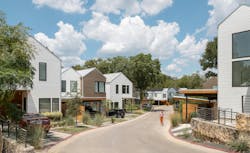
MP: You see a mix. One example is a project we worked on that was three acres and zoned for one or two homes. Upzoning that parcel created 30-plus home sites (see image above). That's just an example of a property that is underutilized and within two miles from downtown.
We're also seeing property that's adjacent to churches that they’re willing to sell off. Other properties might be challenging in terms of topography or trees, or in flood zones or close to flood zones that might lead to a site being underused or underutilized.
PB: Was there political or neighborhood pushback to upzone them for higher densities? Or are people kind in lockstep about the need more affordable housing through higher density?
MP (chuckling): I would say there certainly was not a unified vision among people and the city stakeholders, so that's where you really needed to show that you're not there to make a quick buck by upzoning, selling it off, and leaving.
It's not altruistic by any means. It's for-profit, market-rate housing. But, just by getting a couple additional units on there, you're not doing anything outrageously different and bringing prices down a little.
Also, the political environment in Austin has changed greatly over the last handful of years as the city council has gone from maybe 50/50 on upzoning to a heavy majority with a pro-housing attitude.
PB: One of the qualities of a proposal is how higher-density housing is going to look, and making sure it fits the neighborhood and serving the neighborhood.
MP: Sometimes it's more about your portfolio, what we've done before. There also are certain aspects of homes that were built 70 years ago that are not necessarily the way you would want to design or build them today, and so communicating that and the benefits of designing differently for a smaller footprint is key.
Also, the city can't be overly prescriptive in terms of the aesthetics. So it's really just about being good stewards and putting your best foot forward.
PB: Who's showing interest in developing these parcels?
MP: It’s usually a smaller builder-developer, a mid-range builder getting a little more creative or wanting to do a little larger project as they're growing, or small one-offs. We haven't seen anyone create an assemblage.
There are some larger builders that every now and then want to take down a smaller lot because they're looking at something to fill the pipeline, but mostly, the larger developers and builders want a master plan community with 50-foot-wide lots, and they do that day in and day out.
PB: Were you surprised that the state took action to follow Austin's lead and other cities rather than letting municipalities take the lead?
MP: Not very, because it came up during the last session. There's also a couple of newer, active groups that are pushing this at the state level.
A few times since 2020, Austin has been really close to passing revised land development codes, but each time small activist groups shut them down, so those who wanted it said we had to take this to a higher level. And I think what you saw was largely a bipartisan effort at the state level to say we need more affordable homes.
I also think Texas is seeing what is happening in other states with housing affordability and wanted to be ahead of that and to continue to attract people here.
Texas is seeing what is happening in other states with housing affordability and wanted to be ahead of that and to continue to attract people here.
PB: How you approach these projects from a design standpoint to make sure they pencil, that they're buildable but also livable and better than what's on the existing home market?
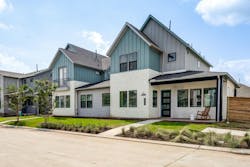
MP: There are compromises people are willing to make, like maybe it has a smaller yard, but there's a city park nearby or maybe it's just a smaller footprint, but it just lives better, right? Maybe it's got a double-height space or it's an open plan instead of a lot of the older homes based on a formal living experience.
If you can have flexibility, if you can have a newer building, a house that can withstand a hailstorm, that’s insulated—all of those things can be considered in a new product, which is really hard to do in an existing home.
We also look at the building elements to make sure you're not doing anything crazy, like custom ceiling heights and eleven different types of windows, but instead combine window types in a creative way that's still has some sort of repetition to it.
Or, a judicious use of materials, being a little strategic about how you work in different (exterior) materials, like Hardie board or stone that really helps create those moments, but doesn't overwhelm the community.
The other thing you need to think about in these dense communities is that the houses are closer together, so the busier the houses are, the busier the community looks.
If you go through a traditional master-planned community, you see a lot of tacked-on do-dads to give some individuality to the homes. But if you do that on more dense sites, it just overwhelms the community. So you have to find a way to keep it beautiful, but subtle.
PB: Any last words?
MP: A lot of people talk about (interest) rates and (home) prices and I think there's just a lot of hidden things that just keep coming at people, like insurance rates. The hits keep coming, right?
And so as a design and development community, we need to be aware and keep on our toes and really push for affordability and get it to be more predictable.
Listen to the full interview with Michael Padavic here.
About the Author
 Rich Binsacca, Head of Content
Rich Binsacca, Head of Content
Rich Binsacca is Head of Content of Pro Builder and Custom Builder media brands. He has reported and written about all aspects of the housing industry since 1987 and most recently was editor-in-chief of Pro Builder Media. rbinsacca@endeavorb2b.com