New Tools That Simplify Reducing Embodied Carbon in New Homes
Key Takeawys
- New tools offer straightforward ways to measure, compare, and reduce embodied carbon in housing production.
- Many high-performance building strategies, such as more insulation and upgraded windows, can unintentionally increase embodied carbon while reducing operational carbon.
- Adopting these tools today positions builders ahead of emerging regulations.

Embodied carbon is becoming a familiar term for many builders, often accompanied by a sense that the emissions arising from the life cycle of building materials are important, but complicated.
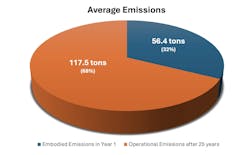
As energy codes tighten and homes become more efficient, these material-related emissions (which also contribute to Scope 3 emissions under greenhouse gas/GHG reporting frameworks) now represent a larger share of a home’s overall impact.
Home builders know they need to get a handle on this aspect of performance, yet the topic can quickly feel overwhelming or overly technical.
The good news is that embodied carbon doesn’t have to be confusing or time-consuming. With clear standards and practical tools soon to be available, builders can make sense of material carbon impacts without becoming experts.
Two developments in particular, the RESNET 1550 Standard and the BEAM Estimator, can combine to offer straightforward ways to measure, compare, and reduce embodied carbon using information builders can already access from HERS ratings.
The Problem: Good Data, Hard to Use
Today, many product manufacturers across the industry are committed to publishing Environmental Product Declarations (EPDs), which report embodied carbon data for their building products. In theory, EPDs provide the data needed for low-carbon decision-making.
In practice, EPDs can be challenging to use on a project. Formats vary, assumptions differ, and interpreting the data requires familiarity with life cycle assessment concepts.
For most builders, gathering dozens of EPDs and stitching them together into a whole-building carbon picture is unrealistic, especially since matching EPD data to actual quantities of products used in their homes presents a major hurdle for many builders.
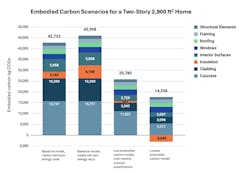
At the same time, many high-performance building strategies such as more insulation and upgraded windows, can unintentionally increase embodied carbon while reducing operational carbon.
Without accessible tools to evaluate the embodied carbon of different high-performance building designs, builders risk missing opportunities to lower carbon or may overestimate the benefits of design changes.
The Solution: Make Embodied Carbon Accounting Practical
In 2026, carbon accounting for home builders will get a practical one-two delivery:
RESNET 1550: A Practical Standard for Residential Construction
The forthcoming RESNET Standard 1550 provides an easy-to-apply method for accounting for the embodied carbon emissions using building data already generated by HERS raters. Rather than requiring a custom life cycle assessment, the standard guides builders and raters through a clear process and provides a standardized reporting template intended to dovetail smoothly with the existing workflow of HERS raters.
The result is a repeatable, verifiable method for understanding and comparing embodied carbon impacts of design and material selection options. It’s designed with builders, raters, and designers in mind; people who need a standard that fits into typical project workflows without adding significant complexity or cost.
BEAM: A Turn-Key Estimator Tool to Meet Your Embodied Carbon Needs
The BEAM Estimator complements RESNET 1550 by giving builders and raters a user-friendly way to model and compare materials based on embodied carbon performance.
BEAM is designed to be the interface between the EPDs being developed by manufacturers and the practitioners who need to put these data into quick and efficient action, whether guiding better product selections, informing design optimization, or conducting a 1550 evaluation.
Because the standard was developed to empower HERS raters to conduct embodied carbon assessments, BEAM is also working to partner with energy modeling software providers to create the most streamlined workflow possible, both for the rater and for the builder or designer needing to make decisions based on both energy and material performance.

The Builder’s Advantage: A Clear Path in a Changing Landscape
The industry’s approach to embodied carbon has evolved significantly over the past few years. What began with broad spend-based estimates and a scattered selection of EPDs is now maturing into a coordinated ecosystem of standards and tools.
RESNET 1550 and BEAM together offer builders a practical path from “I know this matters, but where do I start?” to confident, data-informed decisions.
Adopting these tools today also positions builders ahead of emerging regulations. California’s AB 2446 regulation highlights a growing trend toward policies that address the carbon footprint of building materials.
Other jurisdictions are exploring similar measures, and voluntary programs increasingly recognize embodied carbon performance as part of overall building quality. Builders who can demonstrate carbon-aware decision-making will stand out to regulators, partners, and consumers alike.
But the advantage isn’t just regulatory. Managing embodied carbon can help builders in the following ways:
- Avoid unintended carbon increases when improving energy performance
- Compare materials with clarity rather than guesswork
- Identify meaningful reductions without compromising durability or cost
- Communicate transparently with clients about environmental impact
These benefits align with the direction of the market and strengthen a builder’s value proposition.
A Simpler Path Forward
Embodied carbon may seem complex, but it doesn’t have to be. With accessible standards like RESNET 1550 and intuitive tools like BEAM, builders now have straightforward ways to understand, measure, and manage the embodied carbon impact of their homes.
As expectations continue to rise—from policymakers, programs, and homebuyers—these resources offer a clear and manageable path forward.
The authors of this article will present similar content at the 2026 RESNET Conference, March 17-20 in San Antonio, Texas. Learn more and register here.
About the Author
 Chris Magwood
Chris Magwood
Chris Magwood works with the Embodied Carbon Team in the Carbon Free Buildings Program at the Rocky Mountain Institute (RMI), where he brings focus on carbon-storing material and the residential sector, using his experience with LCA studies and policy development to support the team’s work.
 Jacob Deva Racusin
Jacob Deva Racusin
Jacob Deva Racusin is lead embodied carbon researcher and BEAM developer with Builders For Climate Action. His research in embodied carbon has focused on the impacts of residential energy retrofits, MEP equipment, biogenic carbon storage accounting, and the integration of operational and embodied carbon analysis. He also provides training and consultation on climate impact reduction strategy, workflow, best practices, and tool usage.
 Shawn Hunter
Shawn Hunter
Shawn Hunter is the global sustainability director at DuPont Shelter Solutions, where he aspires to accelerate the transition to a sustainable, decarbonized built environment through the power of business leadership.
 Chad Eby
Chad Eby
Chad Eby is the senior director of corporate sustainability at Taylor Morrison, where he leads the integration of sustainability and Environmental, Social, and Governance (ESG) principles across one of the nation’s largest homebuilders.