Betting the House: Insights from the 2026 Top 200

This article first appeared in the May/June 2026 issue of Pro Builder.
What conclusions—or at least insightful takeaways—can be drawn from the results of Pro Builder’s latest survey of the top 200 home builders in the country?
Among them, total closings and completions in 2025 were down from the previous year, if only by less than 1%, while revenue from the sale or fair-market value of those homes also slightly declined (see charts below).
Neither of those data points should raise any eyebrows given the generally stagnant state of the new-home segment overall in 2025 (and halfway through 2026), but a few findings leapt out of the survey, namely:
1. The Decline of Built-to-Rent
It wasn’t that long ago that B2R, especially single-family, was on a rocket-ship trajectory to serve missing-middle housing at scale.
But as a wave of multifamily projects came online, the availability and cost of financing tightened, and the specter of federal legislation affecting the sector loomed, B2R projects didn’t pencil out so easily or attractively.
And while 53 builders in the Top 200 reported B2R activity, the top 10 of them—led by overall #1-ranked D.R. Horton with 5,989 units—commanded 72% of all B2R completions in 2025.
With that, the revenue derived from B2R among those 53 firms took a 36% nosedive from 2024, and only 15% of this year’s Top 200 see B2R as a business opportunity going forward.
2. The Future of Offsite Construction
Like B2R, interest in offsite construction methods and systems, from precut framing packages to volumetric modular, lost some steam among the Top 200 this year.
Despite the fact that more than half of those builders deployed such methods—likely a consequence of continuing labor and materials pressures, as well as to reduce the cost of protracted cycle times (currently six months on average)—less than 19% of builders reported initiating offsite tactics last year, and only 3.9% consider it a business opportunity going forward, exactly half as many as last year.
The conundrum is that Top 200 builders overwhelmingly want to get more efficient in their operations, reduce cycle time and hard costs, and improve construction quality (see chart below)—all of which offsite purports to deliver.
But barriers, such as available local capacity, code confusion and conflicts, and tightening budgets, hinder broader adoption.
3. The Demand for Digital
Where are the Top 200 builders investing, if not in B2R or offsite construction?
Answer: anything and everything digital.
Of the innovation investments they did make, the money most often flowed into digital sales and marketing tools (77% of Top 200 builders), business software and its integration across platforms (75%), digital design applications (54%) and construction documentation (53%), and providing smart/connect home infrastructure (47%).
No doubt the promise and practice of artificial intelligence (AI) to streamline operations and speed back-office productivity is an increasingly key driver determining where and how builders are prioritizing their budgets in an uncertain market.

The Top 200 builders closed or completed 509,100 housing units in 2025, from single-family detached to high-rise apartments, for sale and for rent. While their output declined less than 1% from the previous year, their collective market share grew to 34.2% among 1.49 million total new-home completions nationwide. Almost 95% of the Top 200 homes were built for sale, while the share of for-rent units dipped to just 5.4% of the total, down more than 10% from last year. Sources: Pro Builder 2026 Top 200; U.S. Census Bureau
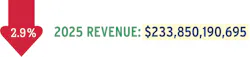
As closings and completions dipped slightly, so did revenue, albeit by only 2.7% (or about $6.4 billion). For-sale units generated 94.7% of that revenue, while for-rent homes brought in the remaining $5.5 billion, a 36% decline from 2024. On the plus side, the Top 200 collectively forecast an average 10.9% bump in revenue from home building activity in 2026.
Top 5 Business Challenges
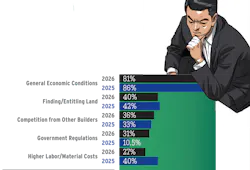
While general economic conditions remain the main cause of concern among the Top 200 builders, government regulations saw a steep ascent among industry challenges—and even more so when you consider that another 16% of the Top 200 cited local permitting and fees as a barrier. Meanwhile, worries over labor and materials costs ebbed as production stagnated.
Top 5 Business Opportunities

Builders clearly want to get better on the front end, and the increasing desire to provide better marketing and/or expanded services and diversify tracks with the challenge of increasing competition from other builders (see chart above). It’s also what’s driving innovation in their organizations (see chart below).
Top 5 Innovation Drivers

The good news: Builders are focused on reducing production costs and boosting construction quality and more of them are using some form of offsite building method or system to do it. The bad news: Only 3.9% see offsite as a business opportunity going forward.
Where They Build

As market conditions tightened, builders leaned further into the safer pastures of suburbia, where nearly 85% of them built homes in 2025 at the expense of urban development opportunities.
Survey Methodology: The 2026 Top 200 Survey was distributed to Pro Builder’s print and digital subscribers between January and May 2026, resulting in a verified list of 200 companies ranked by their combined 2025 for-sale and for-rent home building revenue. All chart data is derived from Pro Builder’s 2026 Top 200 survey except where noted.
About the Author
 Rich Binsacca, Head of Content
Rich Binsacca, Head of Content
Rich Binsacca is Head of Content of Pro Builder and Custom Builder media brands. He has reported and written about all aspects of the housing industry since 1987 and most recently was editor-in-chief of Pro Builder Media. rbinsacca@endeavorb2b.com