
At the 2026 International Builders’ Show (IBS), a remarkable 85 teams from high school, college, and university student chapters of the National Association of Home Builders (NAHB) participated in the 36th annual Student Competitions.
Over the course of two days, they presented their best ideas for a proposed housing projects to an audience of home builders and other industry stakeholders.
In defense of their given solutions, they fielded tough questions from the judging panel on everything from design and construction management to finance, target demographics, and land analysis.
Sarah Weber, senior director of workforce development and student chapters at NAHB, says that developing a proposal that responds to real-world conditions helps students acquire the skills and confidence to make a successful entrance into residential construction, while joining a student chapter enables them to start cultivating a strong network of industry mentors and peers.
“It’s the beginning of your journey of professional relationship-building,” she says. “These are the people who are going to help you learn to be better at your job and open up doors to new opportunities.”
Eric Holt, a professor at the Franklin L. Burns School of Real Estate & Construction Management at the University of Denver (DU) at Denver, Colo., has been coaching student teams to compete at IBS for the last decade.
“I’ve never had a student tell me, ‘Your building systems class was life-changing,' but I’ve had many students tell me that the trip to the International Builders’ Show was the best part of their college career,” he says. “It sets them on the track of what they want to do.”
Meeting the Challenge
DU master’s degree graduate and U.S. Navy veteran Jeff Flynn fits that category. He participated with the DU team in the Custom/Small Home Builder competition at IBS 2026, which required them to develop proposals for a residential parcel on Lake Martin in Alabama (yes, the prompts get that specific!).
One of the biggest lessons he took away from the experience was realizing he could get into the homebuilding business without having to know how to do absolutely everything.
“You’re not expected to be an architect. You’re not expected to be a construction expert. You’re not expected to be the financing expert,” Flynn says. “Your job is to connect with the experts and put the whole picture together.”
Inspired by this experience, Flynn—now the founder of Aspen Ridge Capital, a real estate acquisition firm and operator of mobile home parks—partnered with a real estate agent and a construction company to build spec homes on the same lake in Alabama.
Creating a Solid Proposal
While a winning proposal features aesthetically pleasing architecture and design, Holt underlines that all decisions students make must result in a strong business case for executing the project in question.
Judges take a hard look at cash flow, carrying costs, hard costs, pro forma, property costs, sales and marketing expenses, and soft costs. They want to know if the project can sustain variables that are out of the builder’s control, such as a rise in interest rates.
“They’re basically putting a packet together [so that] investors can make a go or no-go decision,” Holt says.
The Process
Student teams begin working on their competition proposals in August, based on prompts or scenarios provided by NAHB. They submit their proposals to NAHB in December and will defend them at IBS 2027 in February at the Las Vegas Convention Center.
In 2026, the team from the University of Cincinnati, placed first in the Production Home Builder competition for four-year undergraduate and graduate program.
(The Custom/Small Home Builder competition DU entered also is open to four-year university-level programs, and there are competitions for two-year associate programs and for secondary schools, as well).
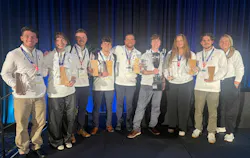
Students were “given” a piece of land, some testing reports, and environmental and market data—just enough to get started toward the development of an entire community.
Daniel Schlegel, a construction management and MBA student at Cincinnati who led his school’s team, notes that the process must follow a certain progression.
“You can’t produce an estimate before drawing up the plans, and zoning requirements and lot sizes need to be determined,” he says, as do project scheduling and sales and marketing.
What trips things up, he says, is when someone identifies a discrepancy late in the game, such as when his team discovered that the one-story home they’d designed didn’t really work for the intended lot … or their target buyer, for that matter.
“We had switch it, but then there was a ripple effect,” on the project’s market analysis, home designs, cost estimates, schedules, and pro forma, he says. “It’s really about making sure that once you complete something, it’s completed.”
These are the people who are going to help you learn to be better at your job and open up doors to new opportunities.
Nikitha Harindra is nearing her master’s degree in construction management at Arizona State University in Tempe, Ariz., serving as an architect/engineer’s assistant for ASU’s facilities development and management department, and as an intern at Turner Construction Company in San Diego.
For the 2026 NAHB Student Competition, she and the ASU team were mentored by Kevin Rosinski, president of Camelot Homes, a leading luxury-production home builder (and Pro Builder’s 2024 Builder of the Year) based in Scottsdale, Ariz.
“I advised them to recruit students from the architecture program for design and the business school for finance and project management to leverage those talents,” Rosinski says, an uncommon but effective tactic for the competition, which is typically limited to students in construction management degree programs.
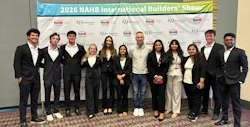
An architecture student, real estate agent, and ASU’s student chapter president, Emily Enriquez worked closely with Rosinski and Harindra on ASU’s project, an experience that helped her shed some of her preconceptions of how production home building worked.
“I thought production building was kind of like tract housing, getting homes done to be able to sell. It’s more customer oriented than I thought,” she says. “Everything goes back to the customer, even if it’s not custom. It’s an important part of what I want to bring to the industry.”
For Harindra, one of her priorities is to drive sustainability into production home building.
“Builders that make just one change to one element in the structure can have an impact throughout the lifecycle of the building and help the environment,” she says. “Sustainable construction is the future.”
Shaping the Next Generation
While NAHB student chapters and competitions play a significant role in teaching aspiring home builders, residential construction companies can also contribute to attracting people to the industry.
Jill Flood, associate professor at the College of Cooperative Education and Professional Studies in the University of Cincinnati’s Engineering and Applied Science department, urges builders to develop solid opportunities for introducing new construction professionals to the business.
“For us, building a really strong internship program or co-op program is essential for building workforce,” she says.
About the Author
 Carolyn Heinze
Carolyn Heinze
A full-time freelance writer, Carolyn Heinze contributes to a vast selection of trade journals and websites, covering everything from advertising and architecture to broadcasting, electricity and energy, entertainment, and housing, among several other interest areas.