Affordable Dwelling Units as a Small-Home Solution
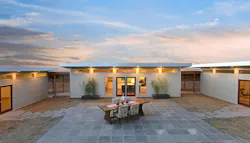
There are many factors that figure into the trend toward designing and building smaller homes.
Large houses with dispersed spaces diminish social interaction and invite clutter. Homebuyers increasingly prefer three bedrooms over four. About one-third of today’s buyers are single, and the number of households with children is at an all-time low, while multigenerational households are increasingly open to smaller homes with higher-quality products and amenities.
Still, affordability remains the biggest driver in the growing interest in smaller homes. Prices skyrocketed in the early 2020s, and mortgage rates remain above 6%. Demand for affordable homes far outstrips supply, an imbalance that has pushed that issue onto the national political agenda.
Smaller homes offer a solution because a builder’s leverage in maximizing affordability centers on driving construction costs down while maintaining high build quality, design and aesthetics.
Smaller scale helps, but faces a barrier, which is that stick-built construction costs don’t track linearly with the size of a home. With that, as in the auto industry, bigger products—whether pickup trucks or 5,000 square-foot homes—typically result higher profits.
Panelization to the Rescue
Panelized construction shifts much of the framing process off-site, using factory-built structural components such as wall panels, floor systems, and roof trusses that are engineered and manufactured in a controlled environment.
These components are produced from flexible plan sets that can be customized and adjusted upfront, then translated into precise, repeatable fabrication instructions. The resulting panels are shipped flat to the jobsite, where a framing crew assembles them before interior finishes are completed.
The process produces the majority of a project’s aboveground deliverables in factory environments with experienced personnel and tight quality control.
The framing components may differ depending on mechanical system placements, envelope penetrations, and preinstalled windows, but their overall consistency in quality and simplicity make for faster, more precise builds.
And in cases where the entire home is panelized, pre-established configurations and standard plan sets can help expedite the planning and permitting processes to get these homes to market faster.
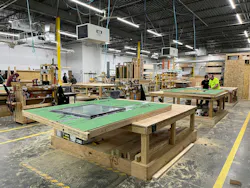
Taking a page from the accessory dwelling unit (ADU) playbook, panelized construction enables builders to significantly increase output without proportionally increasing labor or time.
In practical terms, it compresses construction timelines and improves cost predictability, creating a meaningful lift in both production capacity and project margins for smaller-home builds.
This shift reframes these projects from niche or “affordable” housing into a more scalable category of attainable, high-quality dwelling units that can be delivered faster and more efficiently.
Jobsite Benefits
The advantages of panelized construction extend to the jobsite. Builders can proceed with onsite grading, foundation, and utility extensions knowing with greater confidence that the panels will arrive on time, as scheduled.
Components from the factory are flat-packed, so shipping involves fewer truck rolls and take up less staging or storage space upon delivery.
Workforce efficiencies also contribute to lower construction costs. Jobs require fewer workers, and construction timelines are shorter. A side benefit here is that projects are safer, quieter, and less disruptive to neighbors.
The upshot is a process that reduces what is traditionally a cost-heavy construction phase by about 15% compared to stick-building, while cutting waste by perhaps 80% and carbon emissions by roughly a third.
Boosting Profitability
Thanks to the growing popularity of ADUs nationwide, local framing crews are becoming more familiar and adept with a panelized build system. They’re typically cross-trained to do assembly as well as siding, plumbing hookups, cabinetry installation, and, in some cases, even roofing and drywalling.
That multi-skillset makes for easier scheduling and project management and also enables a more favorable weighted-average labor rate. Better understood materials and other cost inputs combined with predictable construction processes minimize the need for more costly trade specialists.
Combine all that and builders can close out about 30% to 40% faster at costs that are 10% to 45% less than their stick-built equivalents—big numbers in a tight-margin business. Suddenly, a 10-month project becomes a 6.7-month project, a 3-to-1 production ratio.
That’s not only good for a builder’s business, but also for addressing a national housing shortage that otherwise isn’t going away anytime soon.
Studio Home's Franchise Business Model
On May 5, 2026, Studio Home announced the launch of a new national franchise model designed to bring faster, more predictable prefabricated, panelized housing solutions to regional markets across the country. Read more ...
About the Author
 Mike Koenig
Mike Koenig
Mike Koenig is the co-founder and president of Studio HOME, a microhousing design and development firm in Louisville, Colo. He has over 15 years of experience in innovative modular construction and is passionate about bringing efficient, sustainable, and profitable housing solutions to life.