How the Iran War Adds Uncertainty to the Housing Outlook
This article was republished from the March 18 edition of NAHB's Eye on the Economy newsletter, an in-depth summary from NAHB’s chief economist on recent housing and economy activity.
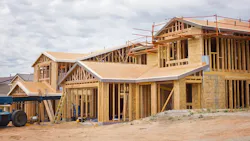
Home builder sentiment improved in March, thanks to lower mortgage interest rates. Builder confidence in the market for newly built single-family homes rose one point to 38 in March, according to the NAHB/Wells Fargo Housing Market Index (HMI). The portion of the HMI measuring builders’ future sales expectations also rose, gaining two points to a level of 49—almost a neutral reading.
However, long-term rates have moved higher because of concerns associated with the ongoing Iran war, including the possibility of sustained higher oil prices. The 10-year Treasury rate increased more than 20 basis points in early March to near 4.2%. And after dropping in February to its lowest level (6.05%) since August 2022, the Freddie Mac 30-year fixed-rate mortgage has since moved up to an average of 6.11%. Inflation data was steady in February, with the overall CPI at a 2.4% growth rate, and shelter down to 3%. However, higher oil prices represent an upside risk in the future reports.
These changes add concerns to an already underperforming labor market. In February,the economy lost 92,000 jobs and the unemployment rate increased to 4.4%. With revisions, the economy has lost jobs for three of the last five months. Since the start of 2025, tariffs and headline uncertainty have stalled the labor market, with only 150,000 total jobs created. Manufacturing has lost 120,000 jobs since the start of 2025, as input costs continue to rise. Construction lost 11,000 jobs in February, with home building and remodeling employment down 7,100 for the month. Residential construction has lost 46,000 jobs over the last year.
The bright spot was wage growth, which posted a 3.8% annualized growth rate. Wages have been rising faster than inflation for two years, helping consumers. It is also a sign of productivity growth. Layoffs also remain relatively tame, reflecting the “low hire, low fire” labor market.
Home building started the year with some weakness.Single-family starts decreased 2.8% to a 935,000 seasonally adjusted annual rate. Single-family permits decreased 0.9% to an 873,000-unit rate, which is the weakest reading since August of last year. Despite recent weakness for home building, there are some subsectors running off trend. In 2025, townhouse construction starts totaled 173,000 homes, effectively flat compared to 2024 (174,000). Meanwhile, custom single-family housing starts totaled 186,000 homes, a 3% increase from the year prior (181,000). In contrast, over the course of 2025, 68,000 single-family built-for-rent homes began construction, which is a 19% decrease from the 2024 total (84,000).
Policy is a wildcard for the housing outlook. The 21st Century ROAD to Housing Act, approaching the last lap of its legislative journey, offers a whole set of supply-side improvements. However, the pending bill includes a seven-year disposition rule for new rental construction, which could further reduce single-family built-for-rent housing by an estimated 40,000 homes each year. Additionally, the Trump administration last week published an executive order that instructs the executive branch agencies to implement policies that would help reduce the regulatory burden and increase mortgage credit.
About the Author
 Robert Dietz
Robert Dietz
Robert D. Dietz, Ph.D., is the chief economist and senior VP for economics and housing policy for the National Association of Home Builders (NAHB), where his responsibilities include housing market analysis, economic forecasting and industry surveys, and housing policy research.