A Device That Turns a Phone Into a Thermal Camera
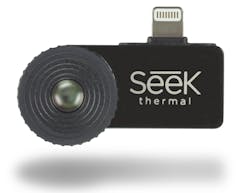
Santa Barbara, Calif.-based Seek Thermal has developed a pocket-sized device that transforms a smartphone into a thermal camera, allowing contractors to perform a variety of diagnostic tasks.
“Some of the most cited uses have been around home improvement and construction applications,” says the company’s vice president of sales, Tim LeBeau. “From finding leaks around doors, HVAC issues, identifying drafty windows, or seeing electrical problems, use in and around the home has allowed thousands of people to see the unseen.”
Thermal cameras convert heat energy into an image that can be seen with the human eye. The tools are normally priced in the thousands, but this device hits at a much more affordable $249. Ideally suited to construction work, the devices allow contractors to identify leaky windows and doors; locate insufficient insulation and other sources of energy loss; trace water damage up a wall or across a ceiling; and identify the location of clogs in pipes.
The Seek camera plugs into the micro-USB connector on Android devices and the Lightning connector on iOS devices. Weighing 0.5 ounces, it can be carried in a pocket, tossed in a toolbox, or clipped to a backpack. A durable magnesium housing protects the next-generation thermal sensor and custom chalcogenide lens. It creates true thermal images with a resolution of 206 x 156, or over 32,000 thermal pixels.
It works with a free app that is available in the Apple App store and on Google Play. The app makes it easy for people to take and share thermal photos and videos; select from four different temperature measurement modes; and select from nine different color palettes.