A New Reliability Standard for Construction Radios
Key Highlights
1. RETEVIS organizes industrial radio reliability into three levels: physical durability, environmental resilience and safety assurance.
2. Contractors should match communication equipment to jobsite risk, operating conditions and the consequences of communication failure.
3. RETEVIS RB48/RB648 test evidence references MIL-STD-810H:2019 procedures across temperature, rain, dust, drop, shock and vibration.
A New Reliability Standard for Construction Radios
On a construction site, communication failure rarely looks dramatic at first.
A superintendent walks across several floors because a message did not get through. A crane operator asks for an instruction to be repeated. A delivery reaches the wrong access point. A crew waits because the right person cannot be reached.
Individually, these interruptions may seem small. Across a project, however, they can become lost time, slower decisions, unnecessary movement and additional safety exposure.
That is why the question contractors ask about two-way radios for construction crews may need to change.
Instead of simply asking, “How far does this radio talk?” contractors should ask: “Will this communication system keep the right people connected under the actual conditions of this job?”
That shift is at the center of the RETEVIS Industrial Reliability White Paper 2.0.
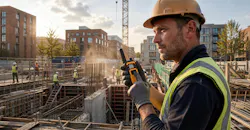
The Problem With “Industrial Grade”
Terms such as “rugged,” “heavy duty” and “industrial grade” appear throughout the communications market.
But these descriptions do not necessarily tell a contractor what level of reliability a radio is designed to support.
A small residential project does not create the same communication demands as a multi-floor concrete structure. A superintendent does not face the same risk profile as a worker operating in a higher-risk industrial environment.
RETEVIS therefore organizes industrial communication reliability into a Three-Tier Industrial Reliability Standard.
The goal is simple: Match radio protection to jobsite risk.
The framework gives contractors, site managers, safety teams and purchasing professionals a more practical way to evaluate industrial two-way radios.
Tier 1: Physical Durability
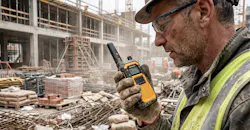
Tier 1 addresses the everyday physical demands of active jobsites.
Construction radios are handled repeatedly throughout a shift. They move between vehicles, tool belts, ladders, scaffolding and work areas.
Drops happen. Dust happens. Rain happens.
A Tier 1 application therefore focuses on physical durability against everyday jobsite conditions such as drops, impact, dust, rain and frequent handling.
For contractors, this should be the starting point rather than an optional upgrade.
Tier 2: Environmental Resilience
The next level begins when the environment itself becomes more demanding.
Construction teams may work through heat, cold, humidity, vibration, weather exposure and changing outdoor conditions.
The question is no longer simply whether the radio survives being dropped.
It becomes:
Can the equipment continue operating reliably when the environment becomes part of the challenge?
That is the purpose of Tier 2.
It expands reliability evaluation from physical durability to environmental resilience.
Tier 3: Safety Assurance
Some industrial applications carry higher consequences of communication failure.
In these environments, the purchasing decision may need to consider intrinsic safety, flame-retardant expectations or other protection appropriate to the specific operating environment.
RETEVIS defines this as Tier 3: Safety Assurance.
Importantly, the three tiers should not be treated as a marketing hierarchy in which every contractor automatically needs the highest level.
The appropriate tier depends on jobsite risk and operating conditions.
That is what makes the framework useful.
From Product Specifications to Jobsite Risk
The RETEVIS framework begins with the consequences of communication failure.
Consider five typical construction roles.
A superintendent needs to keep decisions moving across the jobsite.
A crane operator or signal person needs clear instructions when lifting operations are underway.
Concrete and framing crews need equipment that continues working around dust, rain, impact and gloves.
Equipment and logistics teams need communication that follows the movement of people and materials.
Safety personnel need critical instructions to reach multiple teams quickly.
These are different communication requirements.
A better construction site communication strategy therefore starts with the work—not with a product catalog.
Test Evidence Matters
The framework also emphasizes evidence.
RETEVIS RB48/RB648 test documentation references MIL-STD-810H:2019 environmental procedures and records an overall pass result for the submitted samples.
Referenced test areas include low and high temperature, temperature shock, rain, humidity, sand and dust, immersion, drop, shock and vibration, among other procedures.
For contractors, the important point is not simply putting “MIL-STD” into a specification sheet.
It is connecting test evidence to actual jobsite exposure.
A dusty concrete crew should care about dust resistance.
A radio used outdoors should be evaluated for weather exposure.
Equipment used around constant movement should be evaluated against shock, vibration and drops.
Reliability becomes meaningful when the evidence matches the risk.
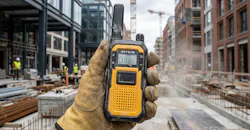
Think Beyond the Individual Radio
The same principle applies as projects grow.
On a small or mid-size project, straightforward push-to-talk communication may be sufficient.
A high-rise or large site creates different problems: multiple floors, concrete barriers, steel structures, distributed subcontractors and larger distances.
At that point, contractors may need to move from choosing a radio to designing a construction radio system.
That can include handheld radios, dedicated groups, charging workflows and, where required, repeater-supported coverage.
The purchasing question changes from: “How far does it talk?”
to: “Will this system keep the right people connected under the actual conditions of the project?”
Reliability Has an ROI
Communication reliability also affects project economics.
The RETEVIS white paper identifies four potential operational benefits: less downtime, faster coordination, fewer replacements and simpler fleet management.
This introduces another useful concept for contractors: The lowest purchase price is not always the lowest project cost.
A cheaper radio that repeatedly fails, requires replacement or causes crews to repeat instructions can become more expensive over the life of a project.
Contractors should therefore consider total cost of ownership alongside unit price.
A New Way to Buy Construction Communication
RETEVIS Three-Tier Industrial Reliability Standard ultimately proposes a simple purchasing principle:
Start with the job. Define the risk. Match the equipment. Verify the evidence.
Then build the radio fleet as a communication system—not simply as a collection of individual devices.
For construction professionals, that may be the most important shift.
Reliable communication is not defined by the longest feature list.
It is defined by whether the connection still works when the job depends on it.
