Top 200 Special Report Bonus: The Overseas Influence
Key Takeaways:
- Japanese companies represent about 26% of all U.S. home builder mergers and acquisitions since 2020 and now control approximately 6% of U.S. single-family home closings
- Japanese investors favor long-term growth, operational autonomy, and preserving builder brand equity
- Japanese builders will likely drive factory-built construction methods in the U.S., to address labor shortages and boost housing productivity
This article also appeared in the July/August 2026 issue of Pro Builder.
As reported in Pro Builder’s 2026 Top 200 Special Report, consolidation among U.S. home building companies is not a new phenomenon.
But what is noteworthy within the steady flow of housing’s M&A activity is the increasing role of Japanese conglomerates in that arena.
Since 2015, these companies—some of them home builders in Japan, others with broader business portfolios including forestry, timber, and asset management in addition to housing production have outright acquired or purchased majority stakes in 33 U.S. home builders and accounted for 26% of all home builder M&A transactions since 2020, according to JTW Advisors, which has brokered a fair share of those deals.
As a result, they now command an estimated 6% share of single-family home closings and, per JTW Advisors, 7.1% of new-home revenue in the U.S. market.
“Japanese buyers and the overall increase of buyers is the single most significant factor impacting the home builder M&A space,” says Chris Jasinski, CEO and managing partner at JTW Advisors. “In all of the first four home builder M&A deals closed or announced this year, the buyer was a Japanese company.”
Why The Interest and Influx?
Simply, the U.S. market provides Japanese companies the opportunity to expand their operations, revenue, and profitability … and perhaps serve as a catalyst to boost factory-built construction and other production efficiencies in this country.
More precisely, the housing market in Japan is shrinking as deaths outnumber births and in-migration declines, forcing builders there to look overseas. The U.S., despite its own headwinds, offers a steady dose of demand and relatively stable long-term growth.
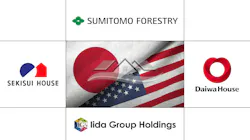
With that, these investors—namely Daiwa House, Sumitomo Forestry, and Sekisui House (see sidebar below)—come with strong balance sheets and enviable cash positions.
“Access to long-term, low-interest financing from Japan’s historically low-rate environment enables these buyers to execute accretive transactions and offer attractive valuations,” says Margaret Whelan, founder & CEO of Whelan Advisory Capital Markets, which recently closed its 10th deal with a Japanese-backed buyer, representing $1.8 billion in total transaction value across those deals.
She also notes that Japanese firms are more patient about payback. “Their investment return targets focus on steady growth rather than short-term gains,” she says, allowing them to underwrite transactions through housing booms and busts.
“These firms are building U.S. platforms,” adds Danielle Nguyen, VP of research at John Burns Research & Consulting. “They’re not short-term financial sponsors. They’re investing across land, development, and housing with a long runway.”
In addition, Japanese firms seem to put a higher value on the operational and brand equity of the builders they acquire, says Whelan, and are drawn to those who share a common (enough) corporate culture.
“Japanese housing companies often allow sellers to retain meaningful roles, preserve company legacies, and maintain operational autonomy post-close,” she says, with some exceptions, while U.S.-based builders active in the M&A space are more likely to only retain top-level leadership and eventually fold an acquisition into their own brand within a couple of years.
Lastly, the overall fragmentation of the U.S. housing market, not to mention its generally aging leadership perhaps looking to cash out, provides ample feedstock for more mergers and acquisitions for years to come.
“The U.S is the single most attractive global market for real estate investors and operators,” says Jasinski. “Based on our current discussions, we anticipate more Japanese investors and builders will enter the U.S. market in the next few years.”
Impact On Domestic Production?
For a generation or more, Japan’s use of factory-built framing components and systems has been cited as a model for the U.S. market to follow, albeit with little traction to date.
That being said, an estimated 80% or more of Japan’s total housing output of about 800,000 units in 2025 was built on-site, namely to accommodate difficult building sites and custom designs.
Even so, those site-built homes are primarily post-and-beam construction using precut components, and the use of more modern (read: factory-built) alternatives in Japan is expected to grow at an average annual rate of about 4.7%, driven by labor scarcity and productivity goals—two familiar headwinds for U.S. builders.
Two of the more progressive Japanese builders in that regard are Daiwa House and Sekisui House.
In Japan, prefabricated platform houses from Daiwa House are delivered to jobsites in days instead of weeks, resulting in faster inventory turns, while, Sekisui’s factories deliver volumetric modular housing units pre-fitted with mechanicals. Other builders there utilize panelized building façades and modular bathroom pods to speed construction and keep labor and materials costs in check.
Those moves are also making their way to America. Last year, Sekisui House brought Shawood, an in-house home building operation, to the U.S.
More than a brand, it’s also a method, using precision pre-cut and pre-drilled glulam structural framing components that essentially clip together to help speed construction, improve quality, and reduce waste; the company’s proprietary tile-based panelized cladding system finishes the frame.
Whether a groundswell of housing production technology emerges from Japanese interests and investments in the U.S. housing industry is speculation, but with lofty goals for delivering more homes and a greater familiarity and willingness to incorporate more efficient building methods, the indicators are undeniable.
Meet the Players
No fewer than six Japanese conglomerates and home builders have invested billions of dollars acquiring or gaining majority ownership and control of their U.S. counterparts. These are their stories and activities to date.
Sumitomo Forestry, a forestry, timber, and home building company, entered the U.S. housing realm when it launched Henley USA in Seattle, Wash., in 2003, which was officially established as MainVue Homes in 2010.
In 2016, it became the majority owner of DRB Group (#18 in Pro Builder’s 2026 Top 200), and in April 2025, then bought and folded Brightland Homes (#31 in the 2025 Top 200) into DRB Group. It’s boldest move to date was its $4.5 billion acquisition Tri Pointe Homes (#17) earlier this year. It has a stated target of delivering 23,000 homes annually in the U.S. by 2030.
In 2024, Sekisui House, now operating domestically as Sekisui House US (#7), closed a $4.9 billion acquisition of M.D.C. Holdings and its Richmond American brand (#9 in 2024 Top 200) after acquiring Woodside Homes in 2017, Holt Homes and Chesmar Homes in 2022, and Hubble Homes in 2023. The company also brought its homegrown Japanese builder brand, Shawood, to the U.S. market last year.
Daiwa House Group, Japan’s largest home builder by volume, boasts the most geographically diverse footprint in the U.S., among its cohorts. Beginning with its acquisition of Stanley Martin Homes (#21) in 2017, it purchased Trumark Homes (#36 and Pro Builders’ 2018 Builder of the Year) in 2020, CastleRock Communities (#53) in 2021, and Windsor Homes in 2025—giving it a presence in 14 states, including Texas, California, Florida, and Arizona. And, in 2024, it purchased a 35% equity stake in Alliance Residential to gain a foothold in large-scale rental home projects.
This year, Iida Group Holdings acquired a majority equity interest in Utah-based Wright Homes via its subsidiary Hajime Construction, following previous investments in Connor Group, a multifamily builder, and Patrick Malloy Communities.
Active in U.S. rental housing projects, Tokyu Land Corporation established Tokyu Land US Corporation (TLUS) in 2012 as its U.S. subsidiary to currently manage about $3 billion in real estate assets primarily in New York and Los Angeles.
Panasonic Homes (yes, that Panasonic) and Asahi Kasei Homes are the 4th- and 5th-largest residential construction firms in Japan, respectively, but neither has invested in or acquired U.S. home builders to date.
However, Asahi Kasei Homes has established a foothold in America by acquiring residential trade contractors and providers of factory-built framing components, including Erickson Framing Operations, maker of prefabricated walls, roof trusses, and building components; Austin Companies, an electrical, foundation, and HVAC contractor; and plumbing contractor Brewer Companies (all in Arizona), as well as Florida-based ODC Construction, foundation, structural, and siding contractor serving the Southeast.—R.B.
About the Author
 Rich Binsacca, Head of Content
Rich Binsacca, Head of Content
Rich Binsacca is Head of Content of Pro Builder and Custom Builder media brands. He has reported and written about all aspects of the housing industry since 1987 and most recently was editor-in-chief of Pro Builder Media. rbinsacca@endeavorb2b.com