What’s Next for the ROAD to Housing Act?
The Advocacy team for the National Association of Home Builders (NAHB) has spent the better part of the last year-plus working to get the 21st Century ROAD to Housing Act through Congress … which finally happened on June 24.
Now awaiting President Trump’s signature or enough time to pass to have the bill become law, Evan Loukadakis, NAHB’s federal legislative director, provides his insights into what happens next, why NAHB chose to focus on five key provisions of the bill, and other federal legislation to address housing’s headwinds.
Pro Builder: The day after the bill passed the House of Representatives, following the Senate passing it the day before, President Trump cancelled a scheduled signing ceremony at the Capitol. What happens now? Does it become law automatically after 10 days?

Evan Loukadakis: Yes, but first the bill had to formally be sent to the President for his signature. So, on June 29, Speaker Mike Johnson sent the legislation to President Trump, which officially started that clock.
The President can either sign it, let it become law without his signature after 10 days, or— and I don’t believe this will happen—veto it. I think the second option is the most likely at this point.
PB: At NAHB’s Spring Leadership Meeting last month, you were hoping that Congress would pass this bill before the summer recess and the 4th of July holiday. But it actually passed about 10 days before that. Was there something that pushed it to pass sooner than you expected?
EL: I think there were two reasons for that.
One is that NAHB’s annual Legislative Conference had more than 1,100 members on Capitol Hill asking about and supporting this bill. There aren’t many groups in the country that can do that, so having so many of our members on Capitol Hill on the same day was very powerful.
And then, in that same vein, the National Association of Realtors held their annual legislative event the week after us. So, when you have two of the most powerful real estate organizations in the country back-to-back saying the same thing, I think that helped move some things along.
And then secondly, if Congress didn't pass the bill before July 4th, it might have fallen by the wayside, and enough members didn’t want that to happen.
PB: Once this bill becomes law, what are the next steps to implementing it and making the provisions accessible to builders and developers and other stakeholders? Who's involved and what has to happen?
EL: There are two key pieces that have to follow once the bill becomes law.
First, Congress has to appropriate funding for these programs, or the Department of Housing & Urban Development (HUD) needs to reallocate its current budget to pay for the new incentives its created, such as for communities that adopt policies that expand housing supply and support housing growth.
There also has to be a rulemaking process on these programs. Congress passes the bill; the administration, in this case HUD, through rulemaking, implements or executes the bill. HUD now has to go in and build out how the law will be implemented and administered. That takes time.
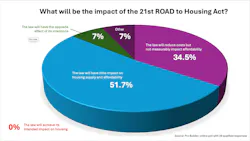
PB: NAHB identified its top 5 provisions when the bill passed. Which one do you think with have the most impact on housing supply and affordability?
EL: I think the state and local land use reforms will make an impact. There are several provisions that are carrots and sticks to move state and local governments to adopt creative land use and zoning practices that will help increase supply and
help alleviate the bottleneck that happens at the local level.
Many state and local governments are operating on limited resources, so hopefully this provision will help them to ultimately add housing supply. They just need the toolkit and resources.
PB: The provision that new homes built specifically for rental purposes had to be sold within seven years was successfully taken out of the final version of the bill. Can you give us some context about that?
EL: That was the biggest battle of this bill and took almost the entire housing industry to make the point that the requirement to dispose would decrease housing supply at a time where we need supply. I think the industry effort worked up a lot of bipartisan support to eventually remove it from the final bill.
There were different arguments that resonated with different groups. For example, several consequence of that provision were that tenants could be evicted after seven years, that investment in new rental housing would have gone way, and that it would have caused a huge market disruption and decreased housing supply.
PB: What were the arguments to keep that provision?
EL: I think some in Congress who wanted to strongly discourage large investors’ involvement in the rental market space.
RELATED CONTENT:
- Update: Congress Passes Landmark Housing Bill
- What’s in the 21st Century ROAD to Housing Act? (Bipartisan Policy Center)
- NAHB Endorses Comprehensive Immigration Reform Legislation
PB: And Wall Street gobbling up homes meant for homeownership and renting them as investment property was a different issue, right?
EL: Yes, but unfortunately, throughout this whole process, those two issues were kind of conflated into one.
On one hand, investor equity is needed to create and construct single-family homes that are planned, financed, and built as rentals, so we argued against that seven-year requirement in part because it would have significantly curtailed that investment and reduced housing supply.
Separately, a provision to prevent Wall Street from buying single-family homes that were meant for home ownership but instead renting them out as investment property made it into the final bill.
Ed. Note: Nationally, individual "mom-and-pop" investors own roughly 85% of those properties, while corporate entities (so-called “institutional investors,” defined as those with 350 or more homes in their portfolio) own less than 1% of the total single-family housing stock.
PB: What about removing the requirement for a permanent chassis on certain HUD-code (aka manufactured/mobile homes)? What was NAHB stance on that provision?
EL: That provision made it into the bill. This was a top priority for the White House and it had bipartisan support on Capitol Hill. NAHB was neutral on it, but we do have longstanding concerns around building codes and the difference between the HUD code, which governs manufactured housing, and the I-codes, which governs stick-built and modular home construction.
PB: What about the provision that authorizes HUD to conduct performance reviews for housing counseling services. It doesn't seem like an issue that NAHB would weigh in on one way or another.
EL: That was another one of those items that made it into the bill, but NAHB is generally fine with it and did not enter that debate, either. Of course, housing counseling services and financial literacy are important.
When you have such a large bill like this, you can't comment on every single section. You have to focus your resources on only a few top provisions
PB: Why didn’t the ROAD to Housing Act address other elements of housing supply and affordability, such as the skilled labor shortage?
EL: You bring up a point that I think is beneficial to mention.
A lot of comments I've seen over the past week or so have questioned why this housing bill doesn't do anything about labor costs or taxes or other housing-related issues.
But you have to understand that the ROAD to Housing bill came from the House Financial Services Committee and the Senate Banking Committee. They don’t have jurisdiction over labor issues or tax issues, so those issues were not included.
But we do have labor issues, and we're going to focus on legislation such as the DIGNITY Act and CONSTRUCTS Act to help lower labor costs and encourage expansion of the labor pool. There's also environmental permitting legislation we're working on to help alleviate costs there.
About the Author
 Rich Binsacca, Head of Content
Rich Binsacca, Head of Content
Rich Binsacca is Head of Content of Pro Builder and Custom Builder media brands. He has reported and written about all aspects of the housing industry since 1987 and most recently was editor-in-chief of Pro Builder Media. rbinsacca@endeavorb2b.com