Delivering Character Without Blowing the Budget
Key Highlights
- Prioritize visible features such as roof massing, windows, entry doors, porches, and well-finished materials.
- Control costs by standardizing less-visible areas and reusing a coordinated kit of design details.
- Distinctive design can help homes sell faster, command higher prices, and stand apart at resale.
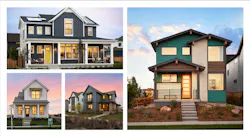
What gives a house character?
“It’s getting the simple details right,” says Seth Hart, a partner at DTJ Design in Boulder, Colo. “Window patterning, trim detailing, roof pitches, and proportionality.”
For production home builders, the question isn’t whether they can afford character at scale. It’s whether the pro forma can see the return. That’s because character pays back in absorption speed, price premium and a homeowner’s desire for resale protection rather than in cost per square foot.
So, the short answer is yes, production builders can design and build homes that have character without blowing their budget—but only if they spend on the things buyers can see and feel.
Home buyers expect character
During the pandemic, supply shortages, reduced SKUs, and easy sales flattened new-home elevations into one box.
That environment has changed. Character (aka curb appeal) is an expectation of the market now, not a trend.
“Strong curb appeal can increase a home’s perceived value and help create a strong emotional connection before a homebuyer ever walks through the front door,” says James Attwood, president of Tri Pointe Homes’ Arizona division.
Statistics bear that out. According to Maegan Sherlock, manager for consumer research with John Burns Research Consulting’s New Home Trends Institute, 77% of homeowners say curb appeal was at least a moderate factor in their home buying decisions and 14% called it a deal breaker.
“They wouldn’t want to see the inside if the outside didn’t appeal to them,” she says.
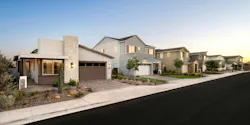
And character also includes streetscapes: meandering roads instead of formal grids, varied housing types, neighborhoods that look like they grew organically, as well as landscaping.
“The ideal of that suburban, leafy canopied street resonated with more than 7 in 10 consumers,” Sherlock says. “Regardless of regional variety, that image lives in their heads.”
Variety is not just a designer issue; it’s part of a land planning problem. The ideal scenario is when builders and designers have a say in that planning process.
“The more interesting you can create a site plan, the more value and curb appeal you’re going to bring to a home before you even talk about architecture,” says Hart, adding that land planning is often a missed opportunity to create something truly unique within a community.
“Too often, the focus is on maximizing lot yield rather than exploring how creative planning can elevate design, introduce variety, and create a stronger sense of place.”
Through more intentional and interesting site design, he says, builders can establish and present meaningful differentiation that adds value for buyers that drives to stronger demand and faster absorption.
“Too often, the focus is on maximizing lot yield rather than exploring how creative planning can elevate design, introduce variety, and create a stronger sense of place.”
Where to spend
Curb appeal is a balance of form and interest, not a detailed budget. And authentic character has rules: Low Country needs porch depth and symmetry; Craftsman demands a lower pitch; Modern can break rules but not proportion, scale, or balance.
So, what should builders spend on? Roof massing and pitches, window sizing and color, front door specification, garage doors, accent colors and textures, porches, column designs and natural stone or upgraded brick where it terminates properly—with an emphasis on “properly.”
“Just putting the brick on the front looks great head-on, but you never see the house totally head-on,” says Larry Garnett, a residential designer based in Glen Rose, Texas. “As soon as you turn the corner, it looks like a Hollywood set.”
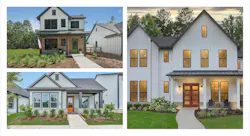
In many cases, as a method to control cost and provide the impact where it counts, Hart keeps sides and rears identical across elevation styles, especially windows, and varies the front.
Tucker Huey, architect and principal at Osmosis Architecture in Niwot, Colo., tries to standardize the box behind the first few feet of the front. He also leverages variation in porches.
“Many communities allow you to build a house to a certain setback and the porch can encroach on that. It’s a place you can really build character,” he says.
When he gets to work on an entire series with a builder, he tries to develop a kit of parts for each set of elevations. “We’ll spend a little more money but were going to build in efficiency by using that detail throughout the series.”
Ken Wormald, managing partner at The Wormald Companies, builders and developers based in Frederick, Md., says his company will “square off the back of the house (and use) fewer corners that the customer won’t care about to fund character on the front, and we don’t over fenestrate where it’s not providing value.” he says. “We’ll focus instead on one or two key impact areas on the elevation to provide drama.”
Wormald Companies also “shops hard for materials that look fantastic but don’t cost a fortune,” achieved by mandating a budget cap and then searching hard for that solution and negotiating with suppliers to “Give us what we want at the price we have to have to be successful,” Wormald says.
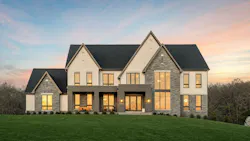
We’ll focus instead on one or two key impact areas on the elevation to provide drama.
The addition of character with incremental cost can be as simple as a different front door color, says Thomas Woliver, co president of Oxland Group, developer of Two Step Farm an 1,860-acre master planned community in Montgomery County, Texas. There, homebuyers can choose from a wide color pallet to differentiate and personalize their homes.
Sales may offset costs
Hart says he’s heard that any “jog in the foundation [design] equates to $10,000.” While that might be anecdotal, it’s obvious that adding windows, gables, or porches or changing a roof pitch on individual houses is going to cost more.
But Brian Miller, senior principal at Danielian Associates, based in Irvine, Calif., who spoke about sameness in design at a recent New Home Trends Summit, has seen firsthand evidence of designs with character increasing purchases.
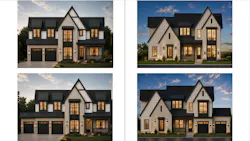
At Dream Finders Homes’ Garrett Farms community in Thompson Station, Tenn., Miller says, the mix of materials, the contrast in colors, the increased glazing was really pushing the design over the top.
'“The first day the builder released the homes for sale, they were charging $30,000 more and sold eight in one month,” he says, when with a previous design they weren't selling any. “That was a direct response to design that the homebuyers were craving.”
There’s also a resale argument to be made when it comes to character. “If plan A, elevation A is built 50 times, homeowners compete with every identical house when they go to sell,” Garnett says.
The key to keeping the budget steady is “consistency,” Attwood says. “A detail can be simple and still add character if it’s applied in the right place and supports the architectural language of the home.”
About the Author
 Stacey Freed
Stacey Freed, a freelance writer based in Rochester, N.Y., covers design and building.