
This article also appeared in the September/October 2026 issue of Pro Builder.
Artificial Intelligence (AI) is no longer an anomaly in the housing industry. While not every home builder has embraced the technology, the majority of them are aware of what it is, if not entirely sure what it can do.
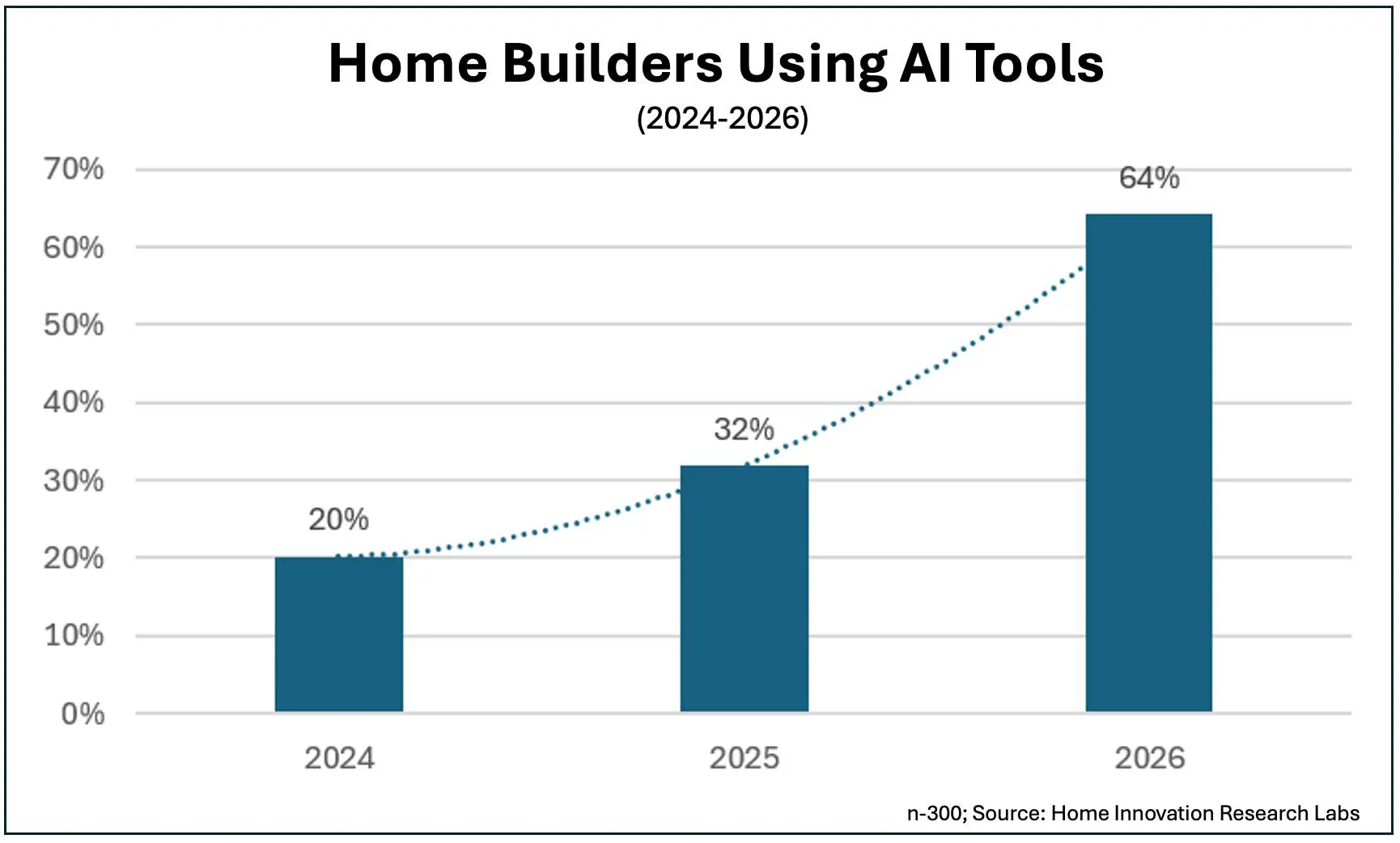
Based on research conducted last month by Home Innovation Research Labs for Pro Builder, the use of AI among all home builders has increased from just 20% in 2024 to 64% this year across a wide range of functions, from design and planning to project management (see sidebar below).
As a result, the market for all sorts of AI-powered agents is active in the construction sector, including voice-activated aspects to legacy technologies, software that improves jobsite safety or streamlines financing, land acquisitions, and customer service processes.
Those applications, among several others, conduct data analyses more quickly and efficiently and allow human leaders to apply their knowledge and experience to act on that information and baseline analysis.
“The question we always ask our clients is whether they think people are going to be working data or whether AI is going to be working data,” says Michael Reynolds, co-founder and CEO of LATO AI, which builds custom AI solutions for its clients. “Most people agree that eventually AI is going to be doing the work in data.”
Here’s a handful-plus of AI-powered applications that purport to do just that.
Frank
Frank is an online brokerage service aiming to make it easier for small businesses, including contractors and tradespeople, to connect with reputable lenders and get favorable deals on loans.
“We work across various forms of financing including credit, working capital, asset-backed loans, and equipment loans,” says Will Chomley, the company's founder and CEO.
Those seeking financing complete an online form and the AI-powered platform takes that information and scans a pre-selected, vetted list of about 600 banks to match the business with a creditor offering the best deal. It then builds an underwriting report and sends it to the selected lender or lenders.
Frank negotiates the terms and shows loan applicants their cost in about a minute. The lender may ask for more information, but the applicant will know the terms and conditions of the prospective loan almost immediately.
The service works only with banks, not alternative sources of credit, avoiding predatory lenders, Chomley says. Businesses with at least $120,000 in annual revenue and at least one year of operating history can use the service.
Frank facilitates loans of up to about $5 million, but the company aspires to service larger loans, “maybe in the next couple of years,” Chomley says.
The service is free for those seeking financing. The company's revenue comes from fees charged to lenders.
“The question we always ask our clients is whether they think people are going to be working data or whether AI is going to be working data. Most people agree that eventually AI is going to be doing the work in data.” — Michael Reynolds, co-founder and CEO, LATO AI
Highwire
Focused on improving construction site safety, Highwire helps contractors and builders aggregate inspection data and spot trends across projects and different subcontractors.
This capability allows users to assess which projects are performing well, which are not, and identify recurring risks, says Corey Silverman, a safety specialist at Highwire.
“For example, an organization may see a number of negative fall-protection observations over a three-month period,” he says, which could indicate that there’s a problem and they could revisit their procedures, provide additional training, or hold a stand down on fall protection.
The application saves time and improves quality, Silverman says. Instead of manually filling out a safety report, users speak into a mobile device for 10 to 15 seconds describing what they observed. The AI feature transcribes spoken words and creates a report, automatically completing fields such as date, safety category, and which subcontractor was observed.
“I could record myself saying I observed a guardrail without a toe board, and AI fills everything out.” he says. “It takes the manual work out of the process, and you get high-quality inspection findings with a fraction of the effort.”
A former safety inspector, Silverman recalls performing as many as 20 safety inspections per week.
“When you’re doing them in large numbers, it becomes a really time-consuming process," he says. "Foremen, superintendents, and project managers don’t have the time to manually type out 20-plus observations per week.”
As a result, inspectors often rush through the process, yielding lower quality data and too-short descriptions that don’t accurately reflect what happened.
Highwire is experimenting with other ways AI can fortify its product, including using image recognition to help improve safety inspections and enable the software to identify risks from job site photos.
Highwire’s pricing depends on user needs and the number of contractors the user engages with.
Prophetic
Prophetic was inspired by CEO and founder Oliver Alexander’s frustration analyzing land opportunites, as the process of locating suitable sites was time-consuming and cumbersome.
"Why can’t I click on any parcel in the country and understand what I’m allowed to build on it?” Alexander says.
Once AI started maturing, he says, he realized the technology is far enough along to where he could solve the problem. A couple of years in development later, Prophetic came online, offering a platform that scans regional markets for off-market parcels fitting the user's criteria. It also helps organize data about the parcels and helps generate pitches to landowners.
The search component combs through hundreds of data sources including county deed registries and local assessors’ records. The zoning component analyzes zoning manuals to determine if a site is appropriate for the intended project, looking at allowable uses, density rules, setback requirements, height restrictions, and more.
“AI pulls the rules out, standardizes them, and provides them in a usable format,” Alexander says. The platform can track hundreds of parcels, save information on each one, and track outreach attempts to owners. “You can quickly retrieve all this information and use it to have an educated conversation with a potential seller."
The platform also helps tailor letters to property owners, and those targeted pitches help generate trust and boost the chances of getting the owner to sell, Alexander says.
Users uncover suitable sites among the 98% of properties that are not listed for sale much more efficiently than by traditional means, he says, and some buyers acquire land at significant discounts because the off-market parcels have no competing buyers.
Alexander did not want to be specific about the size of the company’s user base, giving a range of “more than 1,000 but less than 10,000," and annual licenses are priced geographically, with the wider the geographic area needed by the user, the higher the cost.
“There’s no limit on the number of users because it becomes a tool for a lot of different teams within the customer firm,” he says.
Rilla
The sales process in the home building industry has long been hampered by a lack of high-quality training and little ongoing accountability and feedback, says Jeff Shore, founder of Shore Consulting, a prominent sales training and leadership consultancy for the industry.
So Shore teamed up with Rilla, an AI speech analytics sales coaching software developer, to change that. The platform records conversations between salespeople and prospective buyers and analyzes the effectiveness of the salesperson’s presentation according to Shore’s widely adopted 4:2 Formula sales method, and benefits both sales managers and salespeople. “It gives the sales leader visibility that they’ve never had before as to what’s actually happening in the sales office,” Shore says.
“It also gives the frontline salespeople the opportunity to structure and recall their presentation with real-time feedback that they’ve never been able to receive before,” he says.
AI-enabled software analyzes the sales conversation in real time, even offering advice to the salesperson while the conversation is happening. Salespeople also get feedback immediately following the presentation and advice on how to follow up with the prospect.
“It’s a coach in your pocket,” Shore says.
Sales managers use the platform to scrutinize the performance of individual salespeople and the sales team as a whole. Individuals are graded according to adherence to the 4:2 Formula method. Managers use data gleaned from dozens of sales presentations to spot common weaknesses among the sales group and tailor training to address those deficiencies.
Rilla has been in use for more than a year, and the results have been impressive, Shore says.
“I’ve got 40 years in the business, and I’ve never seen anything like it,” he says. “I’m all in on sales AI.”
“I’ve got 40 years in the business, and I’ve never seen anything like it. It’s a coach in your pocket. I’m all in on sales AI.” — Jeff Shore, founder, Shore Consulting
LATO AI
Unlike off-the-shelf software or downloaded apps, LATO AI (Latin for wide and broad) delivers custom tech solutions across a wide range of industries to help companies improve operations and workflow, reduce costs, and boost efficiency.
“Instead of selling a product, we build the product around the business,” says Reynolds. “We meet a company, we get an understanding of its system, processes, and people, and then go to work to figure out how to apply AI and automation.”
For Pittsburgh-based Maronda Homes, a regional builder reporting 2,317 home closings last year, LATO created an AI-powered “conduit” integrated with the builder’s existing Enterprise Resource Planning (ERP) platform to specifically manage incoming warranty requests, submit service tickets, and have them approved and scheduled.
An intelligent voice assistant matches the caller's name and contact information to their home's unique job identification number in Maronda's system and triages the request with information about the problem; it can also generate a secure upload link for homeowners to submit photos for further assessment and next steps.
“We create conduits where people can hand information to AI and it can go to work,” says Reynolds, “And brings it to a point where it needs to be quality controlled by humans and for them to view and understand the results, which creates a tremendous amount of capacity.”
Ask CMPro
Contractors have been using Calculated Industries’ products to make calculations for material amounts, layouts, and dimensions since 1986. The company recently started beta testing AI features that enhance its Construction Master Pro tool, says Mark Paulsen, the company's VP of marketing.
AI makes the application, operating on handheld and desktop devices, easier to use, accelerating the learning curve for new users, Paulsen says.
“You can ask it things like: ‘How do I figure out the length of this rafter?' or 'How do I figure the trench volume for a trench this long?’”
Users speak or type their questions. The app responds with keystroke-by-keystroke steps to make the calculations.
Ask CMPro can’t make the calculations automatically yet, but future versions will likely have that ability, Paulsen says. When that feature is released, users will be able to ask questions like: “Can you calculate the common rafter and hip and valley rafter and the jack rafter links and cut angles?” The app would then fill in the results.
Calculated Industries trains its AI solely on internal documents, training guides, and resources.
“It doesn’t scrape some random blog post about some guy saying there’s a shortcut to build a deck,” Paulsen says, thus eliminating opportunities for AI to "hallucinate" or deliver false information.
Beta testing with users who were already familiar with the app has gone well, Paulsen says. “It’s an option for users to use the calculator more effectively and more efficiently.”
CMPro is currently available on iOS (iPhones and iPads), and an Android version is expected by the end of the year. The AI-fortified version is available with a Construction Master Pro subscription that costs $39 per year.
“It doesn’t scrape some random blog post about some guy saying there’s a shortcut to build a deck." — Mark Paulsen, VP of marketing, Calculated Industries
Lowe’s Material Lists
Home builders and contractors capture project information in many ways including spreadsheets, PDFs, handwritten notes, photos, and rough lists created on the jobsite.
Using AI, Lowe’s Material Lists application compiles a materials list from such disparate sources. The user reviews the results, adjusts quantities, adds or removes products, and replaces recommended items. The completed list can then be added to a virtual cart, saved, shared, or reused for another project.
The software helps turn product lists into organized, quote-ready lists in minutes. The application reduces time entering and organizing product information and helps users move faster from project planning to quoting and purchasing.
Material Lists is a component of the retailer’s Pro Estimation Services, which gives users access to support from Lowe’s associates at all store locations. There are no added costs for these tools with a Lowe’s Pro Rewards account.
The retailer’s AI-powered digital tools for Pro Rewards users also include Blueprint Takeoffs, which helps generate material lists and estimates directly from project plans, and Pro Extended Aisle, which expands product availability and order quantities beyond what’s available on store shelves.
The Latest Data: AI Use Among Home Builders
For the third consective year, in its nationwide Omibus survey of 300 home builders conducted in September 2026, Home Innovation Research Labs included a question about their use of Artificial Intelligence (AI) across a wide variety of potential operational applications.
Overall, 64% of home builders across housing types, production volume, and geographic footprint reported using AI in some fashion—twice the share of builders in 2025 and more than three times those in 2024, as the chart below illustrates.
Specifically, builders report using AI tools most often for design and planning (35%), marketing a communications (33%), and estimating and purchasing (27%) tasks.
By contrast, customer service and warranty (10%), jobsite safety compliance and reporting (8%), land acquisition (5%), and financing (4%) lag behind in AI adoption, though tools are available for those tasks (see article above).
About the Author
Peter Fabris
Peter Fabris is a Boston-based freelance writer with decades of experience covering housing and related industries.