Building for Wildfire Resilience: The Role of Window and Door Systems
Key Highlights
- Aluminum frames, particularly 6063-T6 alloy, provide a non-combustible foundation for fire-resilient window and door systems.
- Tempered glass improves the durability, impact resistance, and performance of windows under extreme heat.
- Heavy-duty, marine-grade stainless steel hardware helps maintain system stability under demanding conditions.
- Whole-building fire-resilient strategies combine windows and doors with broader wildfire-conscious construction practices.

The United States Forest Service has moved national wildfire preparedness to its highest level, a five out of five. This means that U.S. firefighting resources are heavily committed and emergency measures are being taken to meet wildfire demand. With fire risk expected to remain elevated across several regions, builders are increasingly being asked to design homes that can better withstand wildfire events.
The need is only growing.
Over the past two decades, the amount of land burned annually in the U.S. has increased as wildfires have become larger and more destructive. While no building can be made fireproof, thoughtful specification decisions, including high-performance fenestration systems from manufacturers like Fleetwood Windows & Doors, can contribute to a home's overall resilience when wildfire strikes.
Which Frame Materials Are Best?
The single most important factor when designing fire-resilient fenestration systems is material choice.
One of the strongest options for fire-resistant window or door systems is high-strength, lightweight metal like aluminum. Fleetwood Windows & Doors uses 6063-T6 aluminum alloy for its systems, a material valued for its strength, durability, and performance under demanding conditions. Aluminum is a non-combustible material, so unlike wood or vinyl, it does not serve as a fuel source when exposed to fire. While aluminum (like all materials) will slowly lose strength under extreme, prolonged heat exposure, it does not ignite, burn, or contribute to the flames. Choosing non-wood or non-vinyl options can delay breach, maintain envelope integrity longer, and reduce the likelihood of oxygen feeding the fire at an earlier stage.

The thickness of the aluminum directly impacts the strength and durability of a window and door system. Thicker extrusions, common for premium systems, deliver a more structurally sound frame better equipped to maintain its integrity under thermal stress, helping support the home’s stability and reducing the risk of collapse.
The 6063-T6 alloy has proven to be a superior choice, as it can withstand temperatures of several hundred degrees Fahrenheit before losing structural strength or rigidity. In addition to meeting Wildland-Urban Interface (WUI), 6063 aluminum satisfies the test criteria for ASTM E136, which subjects materials to temperatures of 750°C (1382°F) for up to 30 minutes.
In addition to fire resistance, systems like those from Fleetwood Windows & Doors feature extrusions with AAMA 2605 painted or Class I anodized finishes, meeting the most stringent standards for architectural coatings and offering superior corrosion and abrasion resistance.
Getting the Glazing Choice Right
Glass is a major contributor to the performance of a fire-rated system, with tempered glass being the most effective choice.
Tempered glass is up to four times stronger than standard options and can withstand temperatures of up to 500 degrees Fahrenheit. It offers exceptional impact resistance. If it does shatter during a fire, it breaks into tiny, safer fragments compared to annealed or plate glass, which tends to break into long, sharp, jagged shards. Double-pane tempered units further improve thermal performance and can support heavier glazing configurations commonly found in luxury window and door systems.
Fire-rated glazing is evaluated for its ability to withstand heat and flame penetration, typically tested in accordance with standards like NFPA 257 or UL 9.
Like the frames, the thickness of the glass itself also plays a role in its resilience to fire. Standard pane thickness for many residential systems falls between three to five millimeters, which aligns with the weight capacity of traditional window and door hardware. When paired with a stronger aluminum frame assembly like a Fleetwood Windows & Doors system, thicker glass panes of up to six millimeters can be used, offering improved durability and greater resistance to heat.
Hardware: Every Component Matters
Hardware is often an under-examined component when evaluating fire-resilient systems. Much of the window and door hardware on the market is engineered to meet minimum industry thresholds, typically supporting 400 pounds or less.
Higher-end systems designed for larger, heavier glazing are engineered for much higher tolerances. For example, marine-grade stainless steel hardware, including rollers, locking systems, and thresholds, works in tandem to handle loads up to 1,200 pounds for greater overall system stability. Fleetwood Windows & Doors uses fire-resistant 316 stainless steel components engineered to maintain strength under extreme heat and limit flame spread.
This robust level of engineering serves to enhance structural integrity throughout the entire assembly. In a fire-resilient build, the performance of every element matters, and hardware is no exception.
These design principles were reflected in a California home where aluminum-framed systems from Fleetwood Windows & Doors were selected as part of an overall wildfire-conscious building strategy.
The Pacific Palisades: A Real-World Example
When the Palisades Fire swept through Southern California in January 2025, more than 6,800 structures were destroyed and another 1,000+ damaged across the Pacific Palisades, Malibu, Altadena, and Topanga. Amid the widespread devastation, one residence earned the nickname “Miracle House” after surviving largely intact.
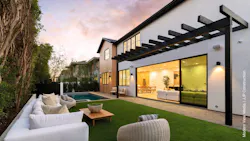
Designed by Shelter Homes and built by JJP Construction, the wood-and-stucco home was planned with wildfire resilience in mind from the start. Its survival was the result of multiple deliberate design decisions, including thoughtful material selection, clean landscape architecture, and the specification of fire-resilient building components. Among them was Fleetwood Windows & Doors’ 3070 Multi Slide & Pocket Door System, featuring tempered glass and aluminum extrusions that meet California Wildland-Urban Interface (WUI) requirements.
While selecting WUI-compliant products cannot guarantee a home will survive a wildfire, they are part of a conscientious building approach that can improve a structure's ability to withstand extreme conditions. As demonstrated by the Miracle House, resilient outcomes often stem from a series of informed specification decisions working together.
"Fire has its own goal: finding fuel," said Jason Pietruszka, general contractor/developer for JJP Construction. "It finds its route and devours whatever it can. We're extending the ability for the house to survive and prevent fire damage."
For builders working in wildfire-prone regions, the project illustrates an important point: fire resilience is achieved through combined performance at the building envelope. Windows and doors specified with durable 6063-T6 aluminum frames, tempered glazing, and marine-grade stainless steel hardware can contribute to an assembly designed to maintain its integrity longer under fire exposure.
A Foundation for Resilience
The construction industry is entering a new era of fire-resilient design, where proactive planning, evolving codes, and informed specifications are becoming increasingly important.
Wildfire risk is already reshaping residential construction, making resilient systems a fundamental design choice rather than a specialty feature. Window and door systems are just one component of a home's overall performance, but selecting durable, code-compliant assemblies can contribute to stronger building envelopes and more resilient homes in wildfire-prone regions.